Hiển thị các bài đăng có nhãn Lincoln. Hiển thị tất cả bài đăng

Thứ Năm, 16 tháng 8, 2012

Lincoln MKZ, 2013


  •  Lincoln MKZ, 2013

Lincoln MKZ Exterior
A sweeping roofline defines the new luxury sedan's profile. The steeply raked windshield and lengthened backlight make for a sleeker and more flowing appearance that is 10 percent more aerodynamic than the model it replaces. "The MKZ shape is a vision completed with just a few strokes," said Wolff.

Though strikingly modern, the design retains classic Lincoln design elements including a more refined interpretation of the split-wing grille, first seen on the 1938 Lincoln-Zephyr.

Rearview mirrors stand on door-mounted, sculpted pedestals. This fitment enables the front door glass to extend farther forward to improve visibility and to allow even more light into the interior.

The crafted headlamp assemblies include bright, energy-efficient LED lighting. The front headlights turn in sync with the steering wheel, providing enhanced visibility. At the rear, LED technology enabled a thin, distinctive full-width taillamp graphic.

The Lincoln MKZ Interior
Design teams created an inviting interior featuring bold architectural elements, rich natural materials and fine details.

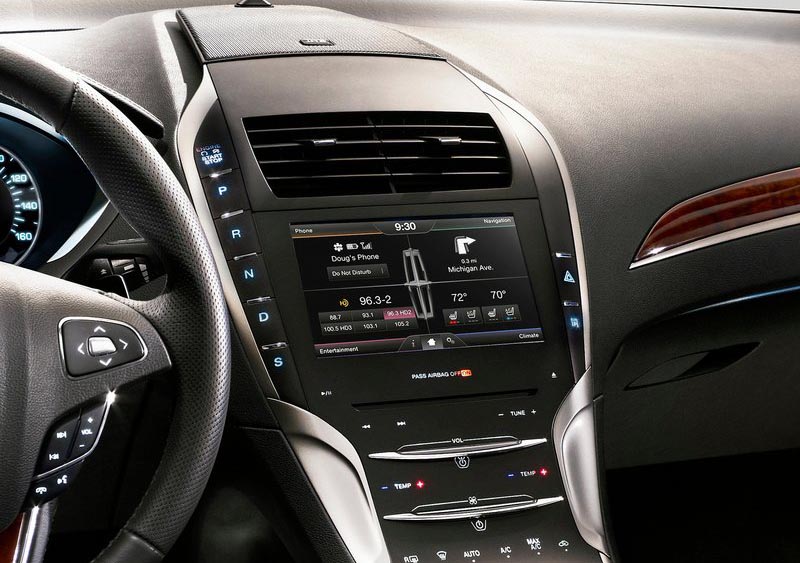
Innovation and technology abound inside the new MKZ. Replacing the traditional mechanical transmission shift lever is a contemporary five-button interface. The individual buttons of Push Button Shift engage Park, Neutral, Reverse, and forward gears in two modes, Drive and Sport.

Push Button Shift gave designers freedom to create a sculptural multi-level center console with more functional storage areas.

Positioned ahead of the driver, the full-color 10.1-inch LCD instrument cluster operates with the latest version of SYNC with MyLincoln Touch. The all-new design combines dimensional indicator rings framing a brilliant and reconfigurable Thin Film Transistor (TFT) LCD. An equally critical component of MyLincoln Touch is the nearly flush-mounted center 8-inch LCD touch screen that displays information clearly in easy-to-reference color-keyed quadrants.

Premium-grade, supple leather covers all seating surfaces. Responsibly harvested wood and metal-toned surfaces create a luxurious and comfortable interior space.

Standard luxury amenities include an 11-speaker audiophile entertainment system and cabin air filtration, plus heated front seats (with the driver's featuring 10-way power controls), remote start capabilities and Active Noise Control.

To make the Lincoln MKZ exceptionally quiet, ANC electronically targets frequencies and reduces their intensity. To improve the refinement of the driving experience, other frequencies are subtly enhanced.

The available THX II Certified Car Audio System is a Lincoln-exclusive that features 700 watts, 14 channels and 14 speakers. THX audio engineers spent more than 200 hours custom tuning the THX-certified equipment to the new MKZ's interior. The result delivers home-theater surround sound to the road.

The new Lincoln MKZ is the only sedan in its class to offer inflatable second-row outboard seat belts. Rear-seat passengers - often children or mature passengers - can be more vulnerable to head, chest and neck injuries. The available inflatable second-row, outboard seat belts spread impact forces across more than five times the area of conventional belts, reducing pressure on the chest while helping to control head and neck motion and helping reduce the risk of injuries.

Camera- and Radar-Based Driving Aids
The new Lincoln MKZ offers the Lane Keeping System, a suite of advanced driving aids that helps drivers avoid drifting from their lane due to distraction or fatigue. Consisting of Lane Keeping Aid, Lane Keeping Alert and Driver Assist, the Lane Keeping System utilizes a mono-vision camera integrated into the rearview mirror to read the lane markers ahead.

Available radar-based (ultrasonic) driving aids further enhance the driving experience. Adaptive Cruise Control and Collision Warning with Brake Support each use a long-range radar system that scans in front of the vehicle, automatically adjusting to traffic speed and providing a visual and audible alert when a potential front-end collision is detected.

Active park assist and Blind Spot Information System (BLIS®) with cross-traffic alert use multiple short-range wide-angle radar sensors. Each function provides a distinct benefit, ranging from making parallel parking easier to warning of oncoming vehicles while backing out of a parking space.

SYNC with MyLincoln Touch
SYNC with MyLincoln Touch is standard in the new MKZ. The combined system makes it easier to use the entertainment, climate and available navigation features as well as devices brought into the car (e.g., phones, PDA, MP3 players). Twin five-way controls on the steering wheel manage essential systems, and many functions can be voice-activated via SYNC.

Standard SYNC Services make turn-by-turn directions available via one button push and simple voice commands. Continually improving voice recognition software learns user voices, improving the efficiency of voice commands.

Lincoln MKZ Dynamic Driving Technologies
The new MKZ offers Lincoln Drive Control as standard. Lincoln Drive Control is an automatic system that delivers an ideal balance of a smooth ride with confident handling as it intuitively responds to driver commands and the road, making the 2013 model the most refined and engaging MKZ ever.

Always on, Lincoln Drive Control orchestrates the performance of the Continuously Controlled Damping (CCD) adjustable suspension, electric power-assisted steering (EPAS), engine, transmission, Active Noise Control (ANC), traction control and stability control systems.

The result is an unsurpassed combination of refined ride and engaging driving dynamics. CCD offers three modes (Sport/Normal/Comfort) that are accessible using MyLincoln Touch. Selecting "Sport" on the Push Button Shift gear selector enables a decidedly more sporty driving experience.

CCD contributes to Lincoln Drive Control's transparent action by monitoring the car's suspension settings up to 500 times per second. The real-time system adjusts the suspension up to 50 times per second to deliver more controlled handling with a smoother ride. CCD augments a highly developed chassis that includes a refined strut front suspension and an all new integral link rear suspension.

The new Lincoln MKZ is the only sedan in its class to include Continuously Controlled Damping and Active Noise Control as standard equipment.

MKZ Engines, Transmissions and Drive Systems
The 2013 Lincoln MKZ offers three distinct powertrains. The standard 2.0-liter four-cylinder EcoBoost® delivers the performance of a traditional V6 along with expected segment-leading fuel economy that is at least 3 mpg better than the closest competitor. This engine delivers a projected 20-percent increase in highway fuel economy versus the 2012 MKZ.

Emphasizing performance and efficiency, the optional 3.7-liter V6 produces significantly more power (37 horsepower and 28 lb.-ft. of torque) than the previous Lincoln MKZ V6 while improving fuel economy approximately 5 percent.

Maximizing fuel efficiency, the optional 2.0-liter four-cylinder hybrid powertrain is expected to enable the 2013 MKZ Hybrid to remain North America's most fuel-efficient premium sedan. The 2012 MKZ Hybrid is rated at 41 city mpg, 36 highway mpg.

Non-hybrid models utilize a six-speed automatic transmission. Standard paddle shifters mounted behind the steering wheel add to the performance driving experience of the Lincoln MKZ.

Improving grip on slippery roads, the available all-wheel-drive (AWD) system anticipates and adjusts the power delivery to the front and rear axles in as little as 16 milliseconds, faster than the blink of an eye.

Retractable Panoramic Roof
The Retractable Panoramic Roof is a new signature feature for Lincoln. The 15.2-square-foot glass panel offers one of the largest openings available on any current sedan. The design maintains the structural strength of a steel-roof vehicle.

Thứ Năm, 17 tháng 5, 2012

Lincoln MKT, 2013


 Lincoln MKT, 2013

The Lincoln MKT full-size crossover offers a dramatically improved ride, sharper handling, better fuel economy and new safety technologies including rear inflatable seat belts for the 2013 model year, providing customers benefits and features that match or exceed more expensive competitors.

NEW STYLING
The changes ensure a recognizable Lincoln family look going forward. The grille and front fascia all are new, as are the wheel selections.

THREE-ROW INTERIOR
Inside, functional, styling and safety updates transform the already distinctive and roomy interior of the new Lincoln MKT into an even more welcoming, luxurious and technologically advanced space.

The significantly revised interior complements the airy feeling afforded by the standard Panoramic Fixed-glass Vista Roof.

The Lincoln MKT offers three rows of seating configured in six- and seven-passenger alternatives. Highlighting the emphasis on first-class travel, those riding in the second row enjoy more legroom than any vehicle in this class. The second-row seats can also be heated and cooled. The second-row refrigerator (integrated into the center console) remains a popular option.

MYLINCOLN TOUCH
Drivers particularly benefit from the latest upgrade of MyLincoln Touch hardware that equips the new MKT with Lincoln's most advanced HMI or Human-Machine Interface.

The all-new instrumentation features a central speedometer flanked by two full-color reconfigurable LCD screens. The 4.2-inch LCD screens are controlled by five-way buttons on the steering wheel. The 8-inch multi-function LCD touch screen dominates the center stack and provides the visual and control interface for the entertainment system, phone, navigation and climate control.

The INFOTAINMENT SYSTEMS

Lincoln MKT offers two audio systems, both controlled through MyLincoln Touch. The standard system includes AM/FM/CD/MP3/satellite sources playing through a 210-watt system that drives eight speakers.

The optional hardware is the THX II Certified Car Audio System that brings home-theater sound to the open road. The 700-watt system plays through 14 strategically aimed premium audio speakers. Sources include AM/FM/CD6/DVD/MP3/HD Radio plus an auxiliary input jack and a USB port. SiriusXM satellite radio with six-month prepaid subscription is standard.

Sirius XM Traffic and SiriusXM Travel Link with voice-activated navigation controls are available. A prepaid subscription to SiriusXM Traffic and Travel Link is included when the available SD card-based navigation system is selected. MyLincoln Touch and SYNC enable voice-activated navigation control. In addition to an easily updateable navigation database, additional Sirius features include coast-to-coast weather data, forecasts, fuel prices, sports scores, movie listings and more.

CRAFTED, NATURAL, COMFORTABLE
Standard 12-way adjustable front seats, adjustable pedals and power tilt/telescoping steering wheel help accommodate a wide range of drivers.

The leather surfaces for the first two rows of seating are provided by the Bridge of Weir leather company. Sourced from Scotland, Bridge of Weir leather can also be found in luxury jets, yachts and covering fine furniture.
The company uses a unique organic tanning method, which produces leather free of chromium - making it one of the most environmentally friendly and fully recyclable leathers available. French and Deck seams add to the interior's high level of finish.

The seat cushions, head restraints and seat backs are made with soy foam, which has a lower environmental impact than petroleum-based foams. In addition, the soy-based materials deliver excellent performance and offer equivalent comfort and durability.

The heated steering wheel is a welcome new option for drivers who live in colder climates. A thin metal element under the wheel's leather-wrapped rim can raise the rim's surface temperature from minus 4 degrees Fahrenheit (minus 20 degrees Celsius) to 74F (23C) in five minutes.
Because interior quietness is a universal luxury cue, the 2013 MKT is significantly quieter than the 2012 model. Additional noise barriers and absorbers were placed in the front wheel wells, around the shock towers, under the hood and in the trunk. The exterior mirrors also were redesigned to reduce wind noise.

IMPROVED SYNC
The next generation of the award-winning SYNC system continues to become easier to use and more robust in its operation. New, simpler screen designs improve the user interface. Larger and bolder fonts make screens easier to read. SYNC's voice recognition experience, powered by Nuance, also improves.

Microsoft's Windows Embedded Auto software platform continues to be the operating platform that will deliver faster response times. SYNC has evolved from a stand-alone module for communication and entertainment to become a fully integrated operating system for Lincoln vehicles with MyLincoln Touch.

As a further enhancement to the SYNC experience, the standard system in the 2013 Lincoln MKT provides Operator Assist as a standard SYNC Services feature, allowing users to connect with a live person free of charge.
SYNC also enables the interior of the Lincoln MKT to become a Wi-Fi hot spot when linked to a data-enabled cellular device. With active Wi-Fi, passengers can link to the Web on gaming systems, PDAs, tables and laptops.

POWERTRAIN
The standard engine for 2013 is a more powerful and efficient 3.7-liter V6 that includes twin independent variable camshaft timing (Ti-VCT). The ability to vary camshaft timing to optimize the opening and closing of intake and exhaust valves increases the engine's power and efficiency.

Horsepower for 2013 increases to 300 from 268, a 10 percent increase achieved with projected fuel economy ratings that improve to 17 mpg city, 25 mpg highway, a 1 mpg highway improvement. The Lincoln MKT now offers more standard horsepower than the Audi Q7 and Acura MDX and nearly matches the 302-hp Mercedes-Benz R350.

Fuel economy for the Lincoln MKT achieved on regular unleaded fuel surpasses these competitors by as much as 4 mpg highway.

3.5-LITER ECOBOOST V6
Nine out of 10 MKT retail customers opt for twin-turbo 3.5-liter EcoBoost V6, an engine that provides V8 performance with the fuel economy of a V6. In terms of horsepower from optional engines, the Lincoln MKT fitted with EcoBoost has no direct competition.

The 3.5-liter gasoline turbo direct-injected (GTDI) engine produces 355 horsepower at 5,700 rpm and an expansive torque curve that plateaus at 350 lb.-ft. of torque from 1,500 to 5,250 rpm. Fuel economy is projected to be 16 mpg city, 22 mpg highway. The EcoBoost V6 earned a slot on Ward's 2010 "10 Best Engines" honoree list the year it was introduced.

EFFICIENT SIX-SPEED TRANSMISSIONS
Lincoln MKT is equipped with two versions of the six-speed SelectShift Automatic transmission, both with steering wheel-mounted paddle shifters. The 3.7-liter Ti-VCT V6 uses the 6F-50, and the more powerful 3.5-liter EcoBoost V6 uses the heavy-duty 6F-55. This transmission features high-energy friction materials, a larger ring gear and a specific torque converter that optimize the 6F-55 to handle the high-torque output of the twin-turbo 3.5-liter.

These gearboxes offer the driver a choice between fully automatic operation and manual control. Intuitive to operate, a squeeze back on either paddle will deliver an upshift, while a gentle push forward on either paddle will induce a matched-rev downshift. Unlike some competitive transmissions, SelectShift won't second guess the driver with an override shift. The manual control is truly controlled by the driver.

ALL-WHEEL DRIVE
All-wheel drive is standard with the twin-turbo 3.5-liter V6. In good weather over smooth roads at modest speeds - when AWD is not needed - the system intelligently routes power only to the front wheels, improving fuel efficiency.

When driver input or road conditions indicate that slip might occur, the system sends power rearward to help prevent tire slip from happening in the first place (such as on rain-slicked or snow-covered roads).

A myriad of inputs enables the computer-controlled system to identify and immediately react - in as little as 16 milliseconds - to changing road conditions and driver demands. The amount of torque sent to the rear axle varies depending on road conditions and dynamic needs.

NEW CHASSIS TECHNOLOGY
Making a full-size crossover ride smoothly but handle well can be a real challenge.

Continuously Controlled Damping (CCD) is fitted to the new Lincoln MKT when the crossover is equipped with the optional 3.5-liter EcoBoost V6 engine. The adjustable suspension enables a more confident driving experience that defines the Lincoln DNA balance of ride comfort and handling. Regardless of road conditions, drivers will enjoy a markedly smoother, more controlled ride because CCD is always tuning and refining the ride quality.

The fully integrated system delivers its on-road benefit by significantly expanding the chassis's capabilities compared to a chassis with nonadjustable struts and shock absorbers, known as dampers by chassis engineers.

REAL-TIME DAMPING
Compared to the fixed-rate damper standard on the 2012 MKT, the CCD damper on the 2013 MKT offers dramatically expanded control range. CCD utilizes 46 inputs to feed data to a sophisticated control unit that continuously monitors more than 23,000 packets of information per second.

The CCD control module reacts to the data by calculating the optimal damping force every 2 milliseconds or 500 times per second. Mechanical adjustments typically occur 20 times per second, but can be as rapid as 50 times per second. On average, large damper force adjustments (such as firm to soft) occur in just 11 milliseconds. For engineers, mechanical actions that occur in less than 13 milliseconds are considered real-time actions.

CCD constantly reads the road surface and continuously adjusts the suspension in real time within the three selectable ranges - Sport, Normal and Comfort. CCD operates so quickly that it can react pre-emptively.

CCD recognizes, for example, when the Lincoln MKT is about to encounter a typical pothole. The system instantly tightens damper control to prevent the wheel and tire from crashing down into the full depth of the pothole. Typically, the damping rate increases by more than 150 percent vs. the system's softest setting, helping to smooth out an otherwise harsh and jarring event. The system is so quick that inputs received at the front wheels are used to prepare the rear wheels to deliver a better driving experience.

"CCD is always active, refining the ride of the new MKT," said Brian Naspinsky, Lincoln Vehicle Integration engineer. "CCD helps reduce body roll by up to 20 percent, making the MKT feel tighter and more buttoned down. Understeer on the MKT has been reduced by approximately 25 percent, so the car feels more eager and ready to respond. Simultaneously, CCD also makes it possible to provide a smoother, more confident ride over virtually any road surface."

LINCOLN DRIVE CONTROL
Three distinct driving modes - Sport, Normal and Comfort - are easy to select using the MKT's new Lincoln Drive Control and the shift lever.

Lincoln Drive Control enables drivers to change the driving personality of the Lincoln MKT:
    Normal mode - When the gear selector is in Drive, Lincoln Drive Control delivers the ideal Lincoln ride, balancing comfort with confident control and handling. Many drivers will find this setting perfect for commuting and everyday driving. This mode provides an engaging drive experience and a direct connection to the road without sacrificing the expected comfort and smoothness
    Sport mode - When the gear selector is in Sport, Lincoln Drive Control transforms this crossover's personality into a more performance-oriented machine. The following systems change settings in Sport mode:
    The CCD suspension switches from operating in its normal range to its firmest sport range (25 to 30 percent more control than Normal), emphasizing handling
    The electric power-assisted steering recalibrates to provide more road feel and greater steering effort
    The engine responds more directly to the driver's inputs
    The transmission upshifts at higher rpm, downshifts become more aggressive, and the transmission will hold gears longer and while in corners. Additionally, sixth gear is locked out
    Traction control and electronic stability control settings are also modified to allow more spirited driving

In addition to Normal and Sport, Lincoln Drive Control offers the Comfort mode. When drivers want the most relaxed driving experience, the Settings menu in MyLincoln Touch offers easy access to the Comfort mode.

The Comfort mode instructs the CCD suspension to run in its smoothest range. The dampers exert 10 to 15 percent less control compared with Normal. The electric power-assisted steering system also reduces the effort needed to turn the wheel at low speeds, for example, as when parking.

The STEERING
The steering system for the new MKT is improved, too. The gear ratio is quicker (15:1 for 2013 vs. 17.1:1 for 2012), making the steering more immediately responsive.

All new Lincoln MKT models benefit from electric power-assisted steering. EPAS replaces the traditional hydraulic-assist power-steering pump with an electric motor. This helps save fuel because the motor operates only when assistance is required, unlike hydraulic systems that run continuously. EPAS was standard on 2010-12 MKT models with the 3.5-liter EcoBoost V6 and is now standard on all Lincoln MKT models. The new EPAS parallels CCD in how it provides a tunable driving experience and an expanded range of adjustability.

Depending on model and the Lincoln Drive Control mode (if so equipped), steering response for the new MKT improved 10 to 25 percent compared with 2012.

EPAS offers additional benefits. At lower speeds, such as when parking, EPAS provides additional boost for effortless maneuverability. At higher speeds, EPAS increases steering effort and feedback, giving drivers more precise steering control.

ACTIVE PARK ASSIST
EPAS is also the primary technology behind the MKT's class-exclusive active park assist (APA). Once engaged via the switch on the center console, ultrasonic sensors precisely measure open spaces to find a suitable parallel parking spot. When engaged, the sensors measure spots and inform the driver of an appropriate spot. With a few actions, the Lincoln MKT steers itself into the open space. The driver retains full control of throttle, brakes and shifting the entire time APA is engaged.

MORE CAPABLE BRAKING SYSTEM
To match the engine's extra power and the suspension's additional handling capabilities, Lincoln has significantly upgraded the MKT braking system for 2013. The new vented front discs measure 13.86 inches (352 millimeters), more than an inch larger than 2012. To enhance brake cooling, the "hat" portion of the front brake disc is also vented, a unique design developed by Ford Motor Company.

Additionally, the diameter of the rear discs increased 0.58 of an inch to 13.58 inches and the discs are now vented. Brake pad area and total swept area increased significantly, with each improvement working together to improve braking performance, reduce brake fade under heavy use and provide the driver with a more direct and linear braking feel.

INFLATABLE REAR BELTS
Second-row outboard passengers - often children or mature passengers - can benefit from available inflatable rear belts, a segment first.

These advanced restraints spread impact forces across more than five times the area of conventional safety belts, reducing pressure on the chest while helping to control head and neck motion.

DRIVER-ASSIST TECHNOLOGIESThe 2013 MKT offers a complete collection of driver assist technologies in addition to the array of six airbags, anti-lock brakes (ABS), traction control and AdvanceTrac® with RSC® (Roll Stability Control™).

Lincoln MKT earned a Top Safety Pick from the Insurance Institute for Highway Safety for 2010 and 2011. To earn the ranking, a vehicle must receive a "good" (the best available) rating in all four of the institute's crash tests: front, side, rear and rollover, and have electronic stability control as an option. The MKT met all current requirements while offering much more technology to assist drivers.

CURVE CONTROL
Curve Control is a dynamic feature designed to help drivers maintain control if they inadvertently take a curve - such as a freeway off-ramp - too quickly. Curve Control senses when a vehicle is entering a curve too quickly, and can automatically apply the braking system to reduce vehicle speed by up to 10 mph in approximately one second. The reduction in speed is often enough to help drivers follow their intended path.

LANE KEEPING SYSTEM
The newly available Lane Keeping System adds to the advanced capabilities already offered on MKT, including collision warning and BLIS® (Blind Spot Information System) with cross-traffic alert.

Lane Keeping Alert helps drivers avoid leaving their lane unintentionally because of distraction or fatigue. When activated by the driver, Lane Keeping Alert utilizes a forward-facing mono-vision camera mounted behind the rearview mirror to begin looking for lane markers.

Above 40 mph, a control unit monitors the data and determines when the vehicle is wandering out of its lane. As the vehicle approaches the outer boundary of its lane, the system vibrates the steering wheel, cueing the driver to pay attention. Sensitivity settings are adjustable via MyLincoln Touch.

None of these technologies actively prevent lane departures. The responsibility for safe vehicle operation remains entirely the driver's responsibility.

Lane Keeping Alert remains dormant when the turn signal is activated or if the driver is engaged in an evasive maneuver.

It works in concert with Lane Keeping Aid. When activated, Lane Keeping Aid will add torque to the steering system to nudge the Lincoln MKT back into the center of its lane if the driver drifts too close to the lane's edge and does not take the needed corrective steering action. The system includes the ability to sense if a driver is driving hands-free. A warning chime sounds to discourage system misuse.

Driver Alert is a third element of the Lane Keeping System. If the system detects a driving pattern consistent with a drowsy driver, a first-level chime will sound and a friendly suggestion of a coffee cup graphic will appear on the left-hand 4.2-inch instrument cluster LCD screen.

If the driver does not respond and the system continues to sense that the driver is fatigued, another warning and chime will occur. Drivers curious about their state of alertness can monitor their performance at any time.

COLLISION WARNING
Collision warning helps prevent common traffic accidents. Forward-looking, long-distance radar identifies potential obstacles. When the danger of a collision is detected, the system warns the driver with an authoritative beep and a simultaneous red warning light projected on the windshield.

These warnings should be enough to allow the driver to brake before the accident. Collision warning also provides brake support. This function enables harder, quicker deceleration to help drivers stop or reduce speed and lessen the collision impact.

ADAPTIVE CRUISE CONTROL
Adaptive cruise control (ACC) is paired with collision warning because both utilize the forward-looking radar system. With a range up to 600 feet, ACC monitors and adjusts the speed of the Lincoln MKT to keep it at a safe distance behind a lead vehicle in the same lane, even in fog or heavy rain.

The scanning radar unit and control module ignores stationary objects as it determines the closing rate toward the vehicle ahead to assess whether it is necessary to automatically adjust the engine throttle setting or engage the braking system.

With the capability to work at speeds as low as 20 mph, drivers can set the system to work during normal commuting, helping reduce driver fatigue. Three programmable system settings are accessed through MyLincoln Touch.

BLIND SPOT INFORMATION SYSTEM
The available Blind Spot Information System (BLIS) with cross-traffic alert can detect vehicles in blind spots during normal driving and traffic approaching from the sides when reversing out of parking spots. BLIS uses radar to detect when another vehicle enters the defined blind spot zone. A light appears on the corresponding sideview mirror to indicate another vehicle is in the defined blind spot.

Chủ Nhật, 1 tháng 4, 2012

Lincoln MKZ Hybrid, 2011


Lincoln MKZ Hybrid, 2011

Lincoln introduced its first hybrid
The new Lincoln MKZ Hybrid - a premium midsize car poised to be the most fuel-efficient luxury sedan in America. Ford Motor Company - America's largest domestic hybrid seller - is further broadening its aggressive electrification plan and second generation of hybrid technology with the new Lincoln MKZ Hybrid. The vehicle was revealed at the 2010 New York International Auto Show.

Lincoln's first-ever hybrid is expected to deliver at least 41 miles per gallon in the city when it goes on sale this fall.

The new premium midsize sedan hybrid joins Ford Motor Company's growing lineup of hybrids, including the Ford Fusion Hybrid - 2010 North American Car of the Year and America's most fuel-efficient sedan - plus the Ford Escape Hybrid and Mercury Milan and Mariner Hybrids.

Introduction of the new Lincoln MKZ Hybrid also complements Ford's aggressive global electrification plan. Ford is introducing five new electrified vehicles by 2013. They include the Transit Connect Electric in late 2010, the Focus Electric in 2011, a next-generation hybrid electric vehicle and a plug-in hybrid electric vehicle (PHEV) in 2012, followed by another next-generation hybrid electric vehicle in 2013.

The Lincoln MKZ Hybrid's projected fuel economy tops its nearest competitor - the 2010 Lexus HS 250h - by 6 mpg. It also trumps the Lexus with room for one more passenger and more standard luxury and segment-exclusive safety features.
The 2011 Lincoln MKZ Hybrid uses Ford's second-generation hybrid technology - the 2.5-liter Atkinson-cycle I-4 hybrid engine, named one of Ward's 2010 "10 Best Engines."

The system combines the best attributes of the gasoline engine and electric battery-driven motors to deliver optimal performance and fuel economy.
Industry-leading fuel economy comes without sacrificing power. The combined gasoline engine and electric motor provide 191 net horsepower. Plus, the pure electric mode on the Lincoln MKZ Hybrid extends to 47 mph - compared with the Lexus HS 250h battery-only mode, which reaches just 25 mph.

More standard luxury
The 2011 Lincoln MKZ Hybrid comes standard with features and technologies that are either not offered on the Lexus HS 250h or are available only at an extra cost. They include:

Smart Gauge with Eco Guide - Ford's highly successful interactive technology provides real-time information to help drivers maximize fuel efficiency, and coaches drivers on how to optimize hybrid performance. Lincoln takes Smart Gauge to the next level of engagement by giving drivers enhanced positive feedback on long-term fuel efficiency and driving performance through the "growth" of virtual small flowers on the system's right-most screen. Lincoln's white flowers, inspired by apple blossoms, remain permanently unless long-term fuel economy is reset.

Lincoln SYNC - The Lincoln-exclusive voice-activated communications and entertainment system provides an omnipresent link to contacts and information. In addition to Bluetooth phone, audible text and MP3 player capabilities, Lincoln customers also can access Vehicle Health Report and 911 Assist.

10-Way Power Passenger Seat - This seat is designed to accommodate a diverse group of passengers. Memory functions enable passengers to fine-tune and recall their positions.
Power Driver Memory Seat Settings - The driver seat memory feature helps ensure personal seating preferences anytime, with the touch of a button.

Heated and Cooled Front Seats - This uniquely engineered system delivers exceptional heating and cooling comfort.
Genuine Wood Trim - In addition to their exquisite appearance, the Swirl Walnut and Olive Ash wood trims offered in the Lincoln MKZ Hybrid are eco-friendly as well. The veneers come from well-managed forests, as defined by strict environmental, social and economic standards, and from other rigorously controlled sources.

Reverse Sensing System - This system senses what drivers might not see behind them and relays an audible alert if objects are near, which increases in frequency the closer a driver gets.
Keyless Entry Keypad - This Lincoln-exclusive feature provides secure entry at a driver's fingertips. A personal combination holds a memory for driver preferences. So if an owner is out for a run and doesn't want to take the keys along, the vehicle can be opened with the touch of a few buttons.

Easy Fuel Capless Fuel-Filler - This Lincoln-exclusive feature uses an integrated spring-loaded flapper door to eliminate the need for a fuel tank screw cap. That means no more fumbling to remove and tighten the cap and less fuel odor on a driver's hands at the pump.

The Personal Safety System - A Lincoln-exclusive suite of seven protection technologies works together as a system to help protect vehicle occupants. The system includes dual-stage front air bags and an occupant classification system to sense whether the passenger seat is occupied. It tailors - or suppresses - air bag deployment to help provide an appropriate level of protection. It also features the Ford Belt-Minder system to remind front-seat occupants to buckle up.

MyKey - The Lincoln-exclusive feature allows parents to program a key to limit speed and audio volume to encourage teens to drive safer and improve fuel efficiency. It also encourages seat belt usage, provides earlier low-fuel warnings, and can be programmed to sound chimes at 45, 55 and 65 mph.
Integrated Spotter Mirrors - The traditional side-view mirrors are designed with a secondary convex spotter mirror in the top outer corner, which provides a view of the driver's blind spot. When traffic enters the driver's blind spot on either side of the vehicle, it is visible in the secondary convex mirror, alerting the driver of obstacles.

The Acoustic Laminated Windshield - This windshield features a layer of sound-absorbent vinyl sandwiched between two sheets of glass, which enhances interior quietness.
The Lincoln MKZ Hybrid also includes standard Bridge of Weir leather seats. The world-renowned luxury leather from Scotland is unembossed, allowing the natural beauty and character of the grain to shine through. The leather is milled for up to 12 hours to ensure a soft hand, and Bridge of Weir uses a chromium-free tanning process, which makes it easier to recycle.

Chủ Nhật, 25 tháng 3, 2012

Lincoln MKS, 2013


 Lincoln MKS, 2013

Better handling, increased power, improved fuel efficiency, additional standard equipment, more refinement and new technologies that help drivers reduce accident risks provide luxury customers with important new reasons to consider the new Lincoln MKS flagship sedan.

The full-size Lincoln MKS sports an updated, sleeker style for 2013 that headlines a range of improvements that match or exceed more expensive luxury-class contenders.

EXTERIOR
The dedicated Lincoln design studio has developed a contemporary new look for the 2013 MKS. Every exterior surface from the A-pillar forward is new, including the grille, HID headlamps, front fascia, hood and front fenders. Continuing the new look are fresh 19- and 20-inch aluminum wheels. At the rear, Lincoln MKS gets a new fascia, LED tail lamps, exhaust tips and a new decklid design that improves access to the trunk.

INTERIOR
These styling updates transform the 2013 Lincoln MKS cabin. Subtle ambient lighting adds to the interior's luxurious, high-tech environment.

INTERIOR FEATURES
The integration of MyLincoln Touch to the new Lincoln MKS complements Lincoln's most advanced instrumentation and controls to date.

The main instruments feature a central speedometer flanked by two full-color reconfigurable LCD screens. Content for the 4.2-inch LCDs is controlled by five-way buttons on the steering wheel. An 8-inch multi-function LCD touch screen dominates the center stack and provides the visual and control interface for the entertainment system, phone, navigation and climate control.

INFOTAINMENT SYSTEMS
The new MKS offers two audio systems, both controlled through MyLincoln Touch. The standard system includes AM/FM/CD/MP3/satellite sources playing through a 210-watt system that drives 10 speakers.

The optional audio system is THX II Certified Car Audio System with AM/FM/CD/DVD/ MP3/HD Radio capability and 16 speakers, including a 10-inch subwoofer. SiriusXM satellite radio with six-month prepaid subscription, an auxiliary input jack and a USB port are also included. System volume automatically adjusts according to vehicle speed, while sophisticated digital signal processing provides spectral balance, a wide dynamic range and exceptional acoustic performance that brings home-theater sound to the road.

SiriusXM Traffic and SiriusXM Travel Link with voice-activated navigation controls also are available. A prepaid subscription to SiriusXM Traffic and Travel Link is included when the available SD-card based navigation system is selected. MyLincoln Touch and SYNC enable voice-activated navigation control. In addition to an easily updateable navigation database, additional SiriusXM Travel Link features include coast-to-coast weather data, forecasts, fuel prices, sports scores, movie listings and more.

LUXURIOUS, ORGANIC, COMFORTABLE
This Lincoln style is supported by equipment that enhances occupant comfort. Standard heated and cooled 12-way adjustable front seats, adjustable pedals and a power tilt/telescoping steering wheel allow a wide range of drivers to feel immediately at home behind the wheel.

Class-leading available equipment also includes a retractable rear sun shade and, new for 2013, multi-contour adjustable front seats and a heated steering wheel.

Lincoln's available multi-contour seats incorporate seven computer-controlled air bladders to provide occupants with maximum adjustment. Four sections in the seat bottom and three in the seat back can be adjusted. Both driver and passenger seats feature individual static settings as well as dynamic massage settings.

The seat surfaces are provided by the Bridge of Weir leather company. Sourced from Scotland, Bridge of Weir leather also can be found in luxury jets, yachts and furniture. Connoisseurs of fine materials appreciate these leathers for their natural beauty, and the company uses a unique organic tanning method which produces a material free of chromium making it one of the most environmentally friendly, and fully recyclable, leathers available. French and Deck seams on all seats add to the interior's high level of finish.
Seat cushions, head restraints and seat backs are made with soy foam, which has a lower environmental impact than petroleum-based foams. In addition, the soy-based materials deliver excellent performance for both comfort and durability.

CRAFTED DETAILS
A new heated steering wheel is a welcome option for drivers who live in colder climates. A thin metal element under the wheel's leather-wrapped rim can raise the wheel rim's surface temperature from minus 4 degrees Fahrenheit (minus 20 degrees Celsius) to 74F (23C) in five minutes.

New woods (Prussian Burl and Brown Swirl Walnut) and leather colors (Hazelnut and Light Dune) complete the extensive list of interior changes for 2013. While there is a consistency to the woods selected for the interior of the Lincoln MKS, no two Lincoln interiors featuring natural woods display the exact same grain pattern.

CONTINUOUSLY CONTROLLED DAMPING
Throughout 13 decades of the automobile's development, suspension engineers have worked tirelessly to find an ideal balance between smooth ride and satisfying, confident handling. Traditionally, smooth-riding cars have not handled well, and sharp-handling cars have ridden harshly.

Regardless of road conditions, drivers will enjoy a markedly smoother, more controlled ride because CCD is always tuning and refining the ride quality. The result of some 4,000 hours of development time, CCD delivers its on-road benefit by significantly extending the chassis' capabilities compared to a chassis with non-adjustable struts and shock absorbers, known as "dampers" by chassis engineers.

REAL-TIME DAMPING
Compared with the fixed-rate dampers fitted to the 2012 MKS, the new CCD dampers for the 2013 MKS offer dramatically expanded control range.

CCD utilizes an array of 46 inputs to feed data to a sophisticated control unit that continuously monitors more than 23,000 packets of information per second. Algorithms react to the data by calculating the optimal damping force every 2 milliseconds or 500 times per second. The system commands damping force changes 20 times per second (20Hz). On average, large damper force adjustments (such as firm to soft) occur in just 11 milliseconds. For engineers, mechanical actions that occur in less than 13 milliseconds are considered real-time actions.

The system's powerful processing speed and fast-acting mechanicals enable CCD to constantly read the road surface and continuously adjust damping rates in real time across the three selectable ranges - Sport, Normal and Comfort. CCD operates so quickly that it can react pre-emptively.

CCD recognizes, for example, when the car is encountering a pothole and can instantly tighten damper control to prevent the wheel and tire from experiencing the full depth of the pothole. Typically, the damping rate increases by more than 150 percent versus the system's softest setting, helping to smooth out an otherwise harsh and jarring event. The system is so quick that inputs received at the front wheels are then used to prepare the rear wheels to deliver a more refined driving experience.

LINCOLN DRIVE CONTROL
Lincoln Drive Control is where the magic happens because it pulls all of the car's adjustable elements - suspension, steering, engine, and gearbox - into one harmonized system. With Lincoln Drive Control, the new MKS feels sporty, nimble and connected.

The Lincoln Drive Control interface lends MKS distinct driving personalities that drivers can select:
  • Normal mode - When the gear selector is in Drive, Lincoln Drive Control delivers the ideal Lincoln ride, balancing comfort with confident control and handling. Many drivers will find this setting perfect for everyday driving as it provides an engaging drive experience and a direct connection to the road without sacrificing the composure and smooth expected from a luxury sedan
  • Sport mode - When the gear selector is in Sport, Lincoln Drive Control transforms the vehicle's personality to deliver a more performance-oriented driving experience. The following systems change settings in Sport mode:
  • The CCD suspension switches from operating in its normal range to its firmest sport range which offers 25 to 30 percent more control than Normal mode, emphasizing handling
  • The electric power-assisted steering recalibrates to provide more road feel and greater steering effort
  • The engine responds more directly to the driver's inputs
  • The transmission upshifts at higher rpms. Downshifts become more aggressive and the transmission holds gears longer and during cornering. Additionally, sixth gear is locked out
  • The vehicle's traction control and electronic stability control settings are modified to allow more spirited driving
POWERTRAIN
The standard engine for 2013 is a more powerful and efficient 3.7-liter V6 that now includes twin independent variable camshaft timing (Ti-VCT). The ability to vary camshaft timing to optimize the opening and closing of both the intake and exhaust valves increases the engine's responsiveness and efficiency.
Horsepower for 2013 increases to a projected 300 from 273 - up 9 percent. Torque improves to 275 lb.-ft. at 4,000 rpm from 270 lb.-ft. At the same time, projected fuel economy increases for the 3.7-liter-equipped sedan - a 3-mpg improvement on the highway versus today's Lincoln MKS. The 3.7-liter delivers an estimated 19 mpg city/28 mpg highwayfor the front-wheel drive modeland18/26 mpg with the all-wheel-drive model.

The Lincoln MKS now offers better standard highway mileage than the 2012 Acura RL, Cadillac STS and Mercedes-Benz E350. Additionally, the Lincoln engine produces its power using regular unleaded fuel, not premium as required by some manufacturers, including Audi, BMW and Mercedes-Benz.

Specific accessory technologies were added to the 3.7-liter V6 to improve fuel economy performance and efficiency. Active Grille Shutters open and close depending on engine cooling needs. When fully closed, the shutters help reduce aerodynamic drag by 6 percent, improving highway fuel economy. A tuned dual-exhaust system enhances low-end torque. Smart Battery Management also contributes to improved economy by prioritizing the recharging of the vehicle's battery at optimum times, such as when the vehicle is coasting.

3.5-liter EcoBoost V6
The premium engine for 2013 remains the twin-turbo 3.5-liter EcoBoost® V6, an engine that provides V8 performance with the fuel economy of a V6. The EcoBoost V6 earned a place on Ward's 2010 "10 Best Engines" list the year it was introduced.
The 3.5-liter gasoline turbo direct-injected (GTDI) engine produces a projected 355 horsepower at 5,700 rpm and an expansive torque curve that plateaus at 350 lb.-ft. of torque from 1,500 to 5,250 rpm. Fuel economy of the EcoBoost/all-wheel-drive powertrain is projected to be 17 mpg city and 25 mpg highway.

The optional EcoBoost V6 is the most powerful V6 among MKS competitors, producing 45 more horsepower than the Audi A6's optional supercharged 3.0-liter V6 and 55 more horsepower than the BMW 5-Series' optional turbocharged 3.0-liter I-6.

EFFICIENT SIX-SPEED TRANSMISSIONS
The 2013 Lincoln MKS is equipped with two versions of the six-speed SelectShift Automatic transmission, both with steering-wheel-mounted paddle shifters. The 3.7-liter Ti-VCT V6 uses the 6F-50. The more powerful 3.5-liter EcoBoost uses the heavy-duty 6F-55 which benefits from high-energy friction materials, a larger ring gear and a specific torque converter to handle the high torque output of the twin-turbo V6.

These gearboxes offer Lincoln MKS drivers the choice of fully automatic operation or manual control. Intuitive to operate, a squeeze back on either paddle will deliver an upshift, while a gentle push forward on either paddle will induce a matched-rev downshift. Unlike some competitor transmissions, SelectShift won't second guess the driver with an override shift. The manual function is truly controlled by the driver.

ALL-WHEEN DRIVE
All-wheel drive is standard with the twin-turbo 3.5-liter V6 and optional on the 3.7-liter V6. In good weather, over smooth roads at modest speeds and when AWD is not needed, the system intelligently routes power only to the front wheels for improved fuel efficiency.

When driver input or road conditions indicate that slip might occur, the system sends power to the rear wheels to help prevent tire slip, for example on rain-soaked or snow-covered roads. Beyond providing more traction, AWD also improves handling by helping to reduce understeer, the tendency of the vehicle to "push" in a corner.

A myriad of inputs enables the computer-controlled system immediately to identify and react in as little as 16 milliseconds to changing road conditions and driver demands. The amount of torque sent to the rear axle varies depending on road conditions and dynamic needs.

CHASSIS ENHANCEMENTS
To match the engine's extra power and the suspension's additional handling capabilities, Lincoln has significantly upgraded the MKS braking system for 2013, giving the driver confidence and control.

New vented front discs measure 13.86 inches (352 mm), more than an inch larger than in the 2012 model. To enhance brake cooling, the "hat" portion of the front brake disc is also vented, a unique design developed by Ford Motor Company engineers.
Additionally, the diameter of the rear discs increased by 0.58 of an inch to 13.58 inches and these are now vented. Brake pad area and total swept area increased significantly, with each improvement working together to improve overall braking performance, reduce brake fade under heavy use and provide the driver with a more direct and linear braking feel.

STEERING
The Lincoln MKS steering system received a thorough makeover for 2013. The gear ratio is quicker (15:1 for 2013 vs. 17.1:1 for today's MKS), making the steering more immediately responsive at all speeds. Additionally, steering boost is now electric rather than hydraulic. The new electric power-assisted steering (EPAS) complements CCD in contributing to the driver-tunable Lincoln Drive Control experience.

Other enhancements contribute to the system's overall improved performance. The steering gear is now solid mounted to the chassis's front subframe. Additionally, a brace has been added under the vehicle (across the transmission tunnel) to strengthen the subframe's mounting points to the chassis.These details help significantly improve the driver's feeling of being connected to the road through the steering wheel. Overall steering response for the 2013 MKS is improved by up to 25 percent.

EPAS offers additional benefits. At lower speeds, for example when parking, EPAS provides additional boost for effortless maneuverability. At higher speeds, EPAS increases steering effort and feedback, giving the driver a more precise steering feel.
EPAS replaces the traditional hydraulic-assist power-steering pump with an electric motor. This helps save fuel because the motor operates only when assistance is required, unlike the hydraulic systems that run continuously. EPAS was standard on 2010-12 MKS models with the 3.5-liter EcoBoost V6, but for 2013, becomes standard on all MKS models.

Software-based technologies, undetectable by the driver, boost the capability of EPAS. Pull-drift compensation detects road conditions such as a crowned surface or crosswinds and adjusts EPAS to compensate. Active nibble control automatically cancels some unwanted steering wheel vibrations at interstate speeds. These actions are designed to give the driver reassurance and maximum control under all driving conditions.

ACTIVE PARK ASSIST
EPAS is also the primary technology behind the available active park assist (APA) system.

Once engaged via a switch on the center console, ultrasonic sensors precisely measure open spaces to find a suitable parallel parking spot. With a few actions (gear shifting, acceleration and braking), the Lincoln MKS steers itself into the open space. The driver retains full control of throttle, brakes and shifting the entire time the APA is engaged.

TORQUE VECTORING CONTROL
Drivers are most likely to notice Lincoln's new Torque Vectoring Control (TVC) system when Lincoln Drive Control is set to Sport Mode. TVC helps the Lincoln MKS drive through corners with greater balance and poise.

TVC individually influences the speed of the front wheels to enhance cornering agility by mitigating against a dynamic condition engineers refer to as understeer. When accelerating through corners and the system detects a drop in traction, TVC precisely applies brake force to the inside front wheel (that has less grip) causing a transfer of engine torque to the outside wheel (that has more grip). This helps keep the MKS tracking on the driver's intended line through the corner.

IMPROVED SYNC
The next generation of the award-winning SYNC system continues to become easier to use and more robust in its operation. New, simpler screen designs improve the user interface. Larger and bolder fonts make screens easier to read. SYNC's voice recognition experience, powered by Nuance, also improves.

Microsoft's Windows Embedded Auto software platform continues to be the operating platform that will deliver faster response times. SYNC has evolved from a stand-alone module for communication and entertainment to become a fully integrated operating system for Lincoln vehicles with MyLincoln Touch.
As a further enhancement to the SYNC experience, the standard system in the 2013 MKS provides Operator Assist as a standard SYNC Services feature, allowing users to connect with a live person free of charge.
SYNC also enables the interior of the Lincoln MKS to become a Wi-Fi hot spot when linked to a data-enabled cellular device. With active Wi-Fi, passengers can link to the Web on their tables or laptops.

LANE KEEPING SYSTEM
New for the 2013 MKS is a Lane Keeping System that complements the complete collection of driver assist technologies, in addition to the comprehensive safety package including six airbags, anti-lock brakes, traction control and AdvanceTrac® ESC (electronic stability control).

Coupled to the new Lane Keeping System is Lane Keeping Alert and Lane Keeping Aid. Together, these technologies add significantly to the advanced driver assistance features already available on Lincoln MKS, including collision warning and BLIS® (Blind Spot Information System) with cross-traffic alert.

Lane Keeping Alert helps drivers avoid leaving their lane unintentionally because of distraction or tiredness. When activated by the driver, Lane Keeping Alert utilizes a forward-facing mono-vision camera mounted behind the rear-view mirror to begin looking for lane markers. A control unit monitors the data and determines when the vehicle is wandering out of its lane. As the vehicle approaches the outer boundary of its lane, the system vibrates the steering wheel, reminding the driver to pay attention.

Lane Keeping Alert is dormant when the turn signal is activated or when the driver is engaged in an evasive maneuver.
Lane Keeping Aid works in concert with Lane Keeping Alert. When activated by the driver, Lane Keeping Aid will gently add torque to the steering wheel to nudge the MKS back into its lane if the driver has drifted too close to the lane's edge. The system includes the ability to sense if a driver is driving hands-free. A warning chime sounds to discourage misuse of the system.

System sensitivity settings are adjustable via the MyLincoln Touch interface. Neither technology actively prevents lane departures. The responsibility for the safe vehicle operation remains entirely the driver's responsibility.

Driver Alert is the third element of the Lane Keeping System. If the system detects a driving pattern typically exhibited by a drowsy driver, a first-level chime will sound and a friendly suggestion of a coffee cup graphic will appear on the left-hand 4.2-inch instrument cluster LCD screen.
If the driver does not respond and the system continues to sense that the driver is fatigued, further warnings and chimes will occur. Conscientious drivers curious about their state of alertness can monitor their performance any time.

AUTO HIGH-BEAM HEADLAMPS
Auto high-beam headlamps also use the windshield-mounted camera to monitor traffic conditions and control high-beam activation.
In darkness, the high-beam headlamps automatically illuminate unless other traffic is detected. The system continuously scans for stimuli - oncoming vehicle lights prompt the lamps to dim, but traffic lights or a road sign's reflection will not affect the high beams. The sensitivity setting can be adjusted from the default setting of "Near" to "Far."

COLLISION WARNING
Collision Warning helps prevent common traffic accidents as forward-looking, long-distance radar identifies potential obstacles.
When the danger of a collision is detected, the system warns the driver with an authoritative beep and a simultaneous red warning light projected on the windshield above the instrument panel.

These warnings should be enough to allow the driver to brake before a potential accident. Collision warning also provides emergency brake support which enables harder, quicker deceleration to help drivers stop or reduce speed to lessen the impact of a collision.

ADAPTIVE CRUISE CONTROL
Collision warning is paired with adaptive cruise control (ACC) because both features use the forward-looking radar system. With a range of up to 600 feet, ACC monitors and adjusts vehicle speed to keep it at a safe distance behind another vehicle in the same lane, even in fog or heavy rain.

The sophisticated radar system and control module ignores stationary objects as it determines the closing rate toward the vehicle ahead to determine whether it is necessary to automatically adjust the engine throttle setting or engage the braking system. Able to work at just 20 mph, drivers can set the system to work during normal commuting, helping reduce driver fatigue.

BLIND SPOT INFORMATION SYSTEM
Blind Spot Information System (BLIS) with cross-traffic alert can detect vehicles in blind spots during normal driving as well as traffic approaching from the sides when the driver is reversing out of parking spots.

BLIS uses radar sensors to continuously monitor each side of the vehicle to detect when another vehicle enters the defined blind spot zone (within 45 feet). A light appears on the corresponding sideview mirror to indicate another vehicle is in the defined blind spot.
On models without optional BLIS, standard spotter mirrors feature an integrated mirror facet that provides a clear view of anything in a traditional blind spot of a typical exterior rearview mirror.

MYKEY
MyKey allows parents or other concerned owners to restrict certain Lincoln MKS features when in the hands of a MyKey driver.

Owners simply program the vehicle key through the message center to incorporate features such as:
  •     A limited top speed of 80 mph
  •     Prevents deactivation of the Traction Control System that limits tire spin
  •     Audio system volume limited to 44 percent of maximum volume
  •     A speed alert chime at 45, 55 or 65 mph

Chủ Nhật, 11 tháng 3, 2012

Lincoln MKZ Concept, 2012


 Lincoln MKZ Concept, 2012

The Lincoln MKZ Concept, revealed at the 2012 North American International Auto Show in Detroit, signals a significant step in Lincoln's reinvention, providing a clear vision of its next-generation vehicles.

The Exterior
The Lincoln MKZ Concept strongly hints at the production model arriving in dealerships later in 2012, as well as Lincoln's design future.

Warm hues are evident in every aspect of the new vehicle's Cognac-colored exterior. The deep finish is achieved with a rich base coat covered in multiple layers of tinted clear-coat finishes.

By retaining key, recognizable brand design elements, the Lincoln MKZ Concept remains clearly identifiable as a Lincoln. One example is the more refined interpretation of the split-wing grille, introduced on the 1938 Lincoln-Zephyr.

The sedan's profile is dominated by a long, sleek and sweeping roofline that allows the design to break away from the traditional sedan three-box shape. The lengthening of the roofline enables a more flowing, elegant and more naturally aerodynamic appearance.

A panoramic glass roof spans uninterrupted from the windshield to the top of the backlight. Integrated into the sedan's aluminum and boron steel superstructure, the fixed-glass expanse extends to the side roof rails of the cabin, creating an airy, open interior.
LED technology enabled an extremely thin and distinctive full-width taillamp graphic. Exhaust tips are cleanly integrated into the rear fascia.

The Interior
The Lincoln MKZ Concept's four-seat interior is open, warm and inviting. "The front graphic is repeated in the dramatic sweep of the instrument panel, helping tie the interior to the exterior. These flowing forms create a comfortable and functional interior that particularly appeals to the younger, more diverse customers we are targeting," said Wolff.

Innovative interior features include push-button transmission gear selection, an open, tiered center console and liquid crystal instrumentation. The reconfigurable 10.1-inch Thin Film Transistor (TFT) LCD positioned ahead of the driver operates with the latest version of My Lincoln Touch as does the nearly flush-mounted center 8-inch LCD touch screen.

Responsibly harvested poplar wood, aluminum in bright and satin finishes as well as leather help create a sculptural, luxurious and comfortable interior space. Champagne-colored leather seats with dark taupe accents feature a champagne perforation pattern, so-called because the perforations on the seat backs conjure the image of champagne bubbles rising from the bottom of a glass.

Lincoln MKZ Concept: Engineering
The Lincoln MKZ Concept is a styling study that rides on an all-new midsize platform. The sedan is capable of utilizing multiple powertrain options in front-wheel-drive and all-wheel-drive configurations.

Like the recently introduced MKS and MKT with EcoBoost, the Lincoln MKZ Concept features Lincoln Drive Control and the sophisticated Continuously Controlled Damping (CCD) adjustable suspension.