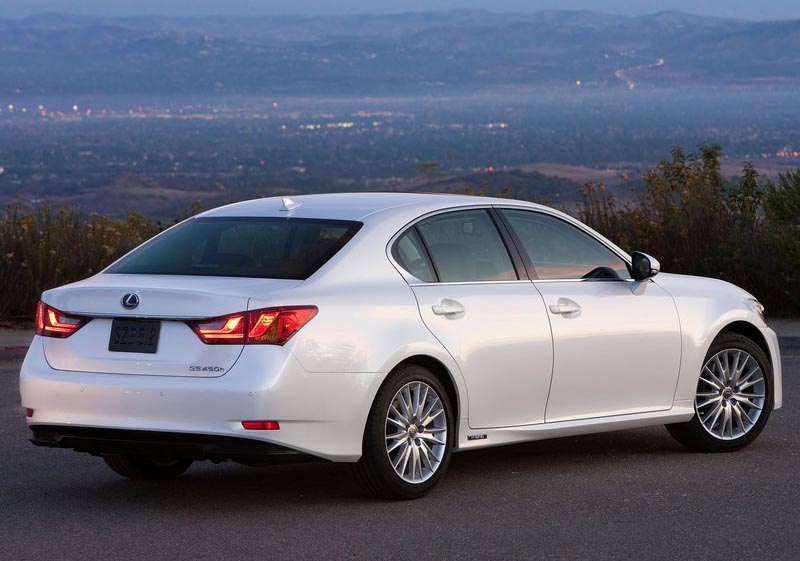
- Lexus GS 250, 2013
The fourth generation Lexus GS features an all-new exterior reflecting a further development of Lexus' unique, L-finesse design philosophy, making the car look bolder and more dynamic.
Though remaining the same length, the new GS has a 10mm shorter front overhang, a 10mm longer rear overhang and is 30mm higher than its predecessor. Improving high speed stability, the front track has been increased by 40mm and the rear track by 50mm. Overall vehicle width has increased by 20mm.
Key to the new design is a more aggressive frontal treatment which gives the new GS the powerful, commanding road presence appropriate to a Lexus sports sedan.
In a further evolution of a styling cue first developed on the CT 200h, the inverted trapezoid upper grille and slanted lower grille have been combined and integrated into a single element, bridging the bumper mid-section to create a prominent 'spindle' shape. The brake cooling ducts at either side of the spindle grille combine a distinctive style with engineering functionality.
The bold, elegant and highly individual grille treatment makes the GS instantly recognisable as a Lexus at first glance, and will be adopted throughout the brand to strengthen the Lexus family identity between model ranges.
The grille is flanked by headlamp clusters clearly positioned on a higher plane than the grille itself. This is a unique characteristic of Lexus models, focusing the eye at the very apex of the vehicle to give the design a resolute look and strengthen the impression of speed and agility.
The headlamps themselves are underscored by newly developed, integral LED Daytime Running Lights (DRL) which form the L-finesse arrowhead motif, further reinforcing the unique visual signature of the new GS.
Exclusive to the hybrid GS 450h, a unique three-lamp design aligns the turn signal and Lexus-first high and low beam LED lamps in a single horizontal row. The improved illumination and beam range provided by LED lamps offers significantly superior visibility even under low beam driving conditions.
Integrating sharply sculpted front foglamp housings, the deep front bumper forms a wide, trapezoid shape which anchors muscular front wings and flared wheel arches, reinforcing the new GS's wider front track, broad stance and powerful road presence.
In profile, the new GS shares its predecessor's long, elegant cabin proportions and slingshot window design highlighted by a stainless steel door frame moulding. But a new, 15mm higher roofline reflects the increase in rear passenger accommodation and boot space whilst providing optimum aerodynamic performance for a drag coefficient of Cd 0.26.
The door handle design has been changed, making it easier to grip, and the smart entry lock mechanism has been changed from a push switch to a touch sensor, improving both appearance and operability. The door mirror now incorporates both an LED side turn signal lamp and a puddle lamp. Both the door panel gaps and the gap between wheel arches and tyres have been reduced, further enhancing the appearance of the new GS model range.
To the rear, the new design narrows behind the flared wheel arches, exposing the lower portion of the rear tyre to emphasise the vehicle's wide rear track. LED lamp clusters feature aero-stabilising fins to enhance the aerodynamic efficiency and driving stability of the car. Uniquely, the rear bumper of the GS 450h covers the exhaust pipe apertures.
In addition to its new headlamp design, the new GS 450h may be further identified by hybrid-specific, front, rear and side blue badging.
F Sport Exclusive Features
The F Sport package is available across the entire GS model range. F Sport exterior design features include exclusive front grille and bumper, rear bumper and lip spoiler treatment, 19" alloys and grade-specific badging.
The F Sport front bumper design features a more three-dimensional form at the sides, incorporating enlarged side grilles. Combined with an exclusive, upper and lower grille mesh design, this reinforces the new GS's more aggressive appearance, wider track and sporting stance.
To the rear, F Sport petrol engine models feature a grey metallic paint finish to the bumper diffuser. The Lexus GS 450h F Sport diffuser combines grey metallic paint with a chrome plated moulding to the lower section of the bumper to further enhance the vehicle's road presence.
All F Sport models further benefit from a grade-specific rear spoiler and exclusive, dark premium metallic 19" alloy wheels.
Exterior Colours
The new GS is available in a choice of 11 colours, including three that are new to the Lexus colour palette: Crimson Red, Meteor Blue and Sonic Silver. Vehicles in Crimson Red benefit from glass flakes incorporated into the coating, adding a high level of brilliance to the paint.
Lexus engineers developed a new advanced coating process for the Sonic Silver finish. The new GS is the first Lexus to adopt this new coating technology. Vehicles with the Sonic Silver exterior appear more radiant as an additional metallic texture gives both strong shading and defined, sharp highlights. This metallic effect makes subtle and defined bodylines more noticeable and the surface appear finely polished.
INTERIOR DESIGN
An ergonomically designed, driver-focused cockpit enabling customers to remain alert and comfortable over long periods of time is an essential requirement of a sports sedan.
The new GS interior represents a continuation of the next generation Lexus interior design theme first seen in the CT 200h. With all functional driving components consolidated in the driver's seat surroundings, it combines outstanding ergonomics with advanced Human Machine Interface technologies.
Driver Focused Cockpit
A clean, elegant dashboard design forms a wide horizontal plane, emphasising the overall roominess of the interior, whilst the door and centre console trim support the driver and front passenger in a secure, cocooned environment.
The dashboard is divided into two distinct zones: an upper Display Zone, with the largest, ultra-wide, 12.3 inch, LCD multi-display screen yet installed in a production car, located at an ideal distance for at-a-glance viewing, and a lower Operation Zone, which allows access to system controls such as the second generation of Lexus' award winning, computer mouse-style Remote Touch Interface (RTI).
Every aspect of the driving position has been carefully considered to create the ideal placement of controls, maximise comfort and minimise driver distraction and fatigue
A new front seat features a lower hip point, placing the driver closer to the GS's centre of gravity, and combines optimum holding ability with superlative comfort. An extended seat sliding range caters for the widest possible cross-section of occupants. As well as a new mid seat back folding adjustment, multiple adjustment mechanisms include a butterfly headrest, shoulder support, side support, 4-way lumbar support, and a cushion length adjustable by 76mm .
The airflow volume of the seat ventilation system has been increased to almost twice that of the current model. And soft padded, tactile finishes to the centre console arm rest, knee pads and door arm rests further enhance the long-distance comfort of the driving position.
The steering wheel features an enlarged, 50mm telescopic reach to bring it closer to the driver, and has been set at a low angle to facilitate large steering inputs without the need for the driver to move their body unnecessarily through over-reaching. Even the cross-section has been painstakingly analysed; no longer uniform throughout the entire circumference of the wheel, its varying profile allows for a relaxing grip and smooth steering inputs.
Brake pedal operability has been optimised with a new pedal shape and surface angle, and the footrest size increased to 300mm for a better fit and greater comfort.
The driver's instrument binnacle incorporates large diameter Optitron dials. Minimising the driver's eye movement from the road ahead, a new Head-Up Display (HUD) relays essential driving information. Its visibility has now been significantly improved. By implementing a wedge-shaped glass for the windshield and the PVC film for displaying information, the clarity of projection has been increased as well as double image projection avoided. The HUD now displays a wider range of information including SPORT mode (tachometer) display and ECO bar display in addition to the speed and audio displays already implemented.
The driver's forward visibility has also been maximised - slim A pillars and a taller windscreen creating a wider field of view. And even the bonnet visibility range has been tailored to allow the driver to readily establish the vehicle extremities, making it easier to place when manoeuvring in confined spaces.
Comfort, Convenience and Contemporary Craftsmanship
Despite having an identical wheelbase length to that of its predecessor, the new GS offers increased space and comfort to all vehicle occupants. Both front and rear door openings have been designed for maximum ease of ingress and egress, with a particular focus on head clearance.
Front cabin occupants benefit from a new seat back design which is more comfortable for taller passengers. A greater seat sliding range and seat height adjustment give an increase in legroom and up to 30mm of extra headroom.
Rear seat passengers benefit from new seats with a revised seat back angle and redesigned cushion shape for greater comfort. A thin front seat design improves knee room by 20mm, and headroom has been increased by 25mm.
Allied to a new, more compact rear suspension layout, a wider opening, increased deck length and reduced deck height combine to make the new GS's luggage space more practical, and significantly increase its volume to up to 566 litres (a 31% increase over the current GS 350). The smart-packaging of the hybrid battery into a stacked format also increased the GS 450h's luggage capacity to up to 482 litres2 (a 61% increase over the current GS 450h).
Throughout the interior, high-quality materials and finishes convey a contemporary, premium look and feel, with a level of craftsmanship and attention to detail for which Lexus is globally renowned.
A new interior colour scheme replaces the traditional two-tone design with a more versatile palette. The dashboard, floor and steering wheel are uniformly black to create a sporting, luxurious feel. And the leather instrument panel features coloured stitching - available in grey and ivory depending on the interior tone- to enhance the premium quality of the cabin environment.
Matching seat and door upholstery will be available in a choice of six colours - Black, Ivory, Grey, Saddle Tan, Topaz Brown and Garnet. In addition to Ebony, Walnut and Bamboo wood finishes, newly developed Black Gloss and Aluminium bring a contemporary, artistic look and feel to the interior ornamentation.
A world first, the steering wheel of the GS 450h will be available in a real bamboo finish, symbolising the innovative spirit and environmental credentials of the vehicle's Lexus Hybrid Drive system.
The GS interior's air of sophistication and luxury is reinforced through Lexus' painstaking attention to detail throughout. It incorporates exquisitely crafted details such as satin metal trim, high quality stitching and the brushed aluminium knobs of the audio system. A new analogue clock with LED indicators, carved from an ingot, adds a unique touch.
The beautifully crafted interior is complimented by an all-white LED interior lighting system which creates an atmosphere appropriate to a premium performance sedan. Reinforcing the GS's highly refined on-board ambience, elements of the LED lighting illuminate to greet the occupants as they approach the car, even before it is unlocked, activating and fading thereafter in sequence with the vehicle starting procedure.
F Sport Exclusive Features
F Sport model interior design features include matching door and seat upholstery also available in Garnet -a grade-exclusive colour, combined with newly developed Aluminium ornamentation, 16-way electrically adjustable F Sport front seats, a black headliner and pillar finish, a dimple perforated leather steering wheel and gear knob, Aluminium pedals and dashboard trim, exclusive black logo scuff plates and F Sport badging to the steering wheel.
INNOVATIVE ON-BOARD TECHNOLOGIES
Several highly innovative technologies make a first appearance in the new GS model range, including a new, energy saving air-conditioning system with S-Flow and 'nanoe' technologies, a second generation Remote Touch Interface (RTI) linked to the world's largest on-board multi-information display screen, and a choice of audio systems offering unparalleled power and clarity.
Second Generation RTI with 12.3" Multimedia Display
The second generation Lexus Remote Touch Interface (RTI) multi-function control device has been enhanced for increased user-friendliness and ease of operation.
It now features the world's first slide haptic joystick mechanism -a planar slide-type controller that is much like a computer mouse, and the ENTER command is now accomplished by simply pushing the controller. Usability has also been improved through the addition of ambient lighting, and by minimising the difference in height between the RTI controller and the armrest.
RTI allows users to manipulate the cursor quickly and easily across the world's largest on-board multimedia display; a 12.3 inch, full colour, LED screen with an ultra-wide, 24:9 format. The screen's size allows for the permanent display of two types of information simultaneously, such as map/audio, night view/map and navigation input/incoming call.
Improved Navigation System
The new GS' navigation system has been enhanced by using also TPEG (Transport Protocol Expert Group) data including TFP (Traffic Flow and Protection) information, parking lot availability and fees which additionally allows to set a certain parking slot as destination.
S-Flow Air Conditioning with Nanoe Technology
Considerably more powerful than the previous system, the new air-conditioning features S-Flow technology to maintain optimum occupant comfort whilst significantly reducing power consumption. Using sensors it determines if the front passenger seat is occupied. If not, the system automatically closes all vents serving this seat. The same happens to the rear seats when the S-Flow button is switched on. This maximises system efficiency.
In addition the system measures the ambient air temperature, interior air temperature and insolation to determine the optimal level of air conditioning. The target airflow volume is customised for each seat through Temperature Airflow Output (TAO) control. When the thermal load is large (cooldown in summertime, warm-up in winter) air conditioning is implemented in the entire car to quickly obtain a comfortable interior temperature. Once the overall interior temperature is stabilized, the system concentrates only on occupied seats.
During the development of the centralised occupant sensing control system, intensive vehicle tests in wind tunnel facilities were performed. The system was also repeatedly tested on both test courses and actual roads to ensure it maintains comfortable driving in a range of environments.
In addition to the TAO control, upper and lower independent, multilayer air mix technology has been adopted to achieve an environment tailored for both driver, front and rear passengers. This allows for example to set the upper air mix for coolness to deal with effects of solar insolation, and at the same time the lower air mix for warmth.
The new system also introduces a 2-tier Interior / Exterior Air Control which prevents window fogging by inducing low humidity exterior air to the upper half of the cabin while maintaining excellent heating performance in the foot area by circulating interior air. This avoids ventilation losses which are characteristic to conventional control system where cold exterior air is induced into heated interior air.
The new GS is also equipped with a new deodorizing filter, which, in addition to the removal of pollen and dust, etc., also removes exhaust gas from the ambient air.
In addition, the air conditioning system incorporates a new 'nanoe' technology system. This air cleaning technology operates automatically when the air conditioning is turned on. It releases 20 to 50Nm diameter nanoe particles -negatively charged ions wrapped in water molecules- into the cabin via the driver's side dashboard air vent.
By attaching themselves to airborne particles and molecules, the nanoe ions have been said to have both an air purifying and odour eliminating effect. They also deodorise vehicle seats and ceiling to create a cleaner cabin environment.
In addition, because nanoe moisture content is approximately 1,000 times that of conventional ions, the emission of ions bonded to water molecules is said to have a moisturising effect on skin and hair, acting to enhance occupant well-being.
Audio Systems
The new GS range may be equipped with a choice of two audio systems.
The standard system represents the next generation of realism and clarity in Lexus sound. It features a fully digital Class-D amplifier capable of creating virtually distortion-free sound with minimal voltage losses. The natural sound dynamics and rich harmonies generated by the high definition amplification are faithfully reproduced by an enhanced, 12-speaker layout which features a new, front three-way system.
The new top of the range 17-speaker Mark Levinson® Premium Audio system creates sound based on the concepts of Effortless Dynamics and Effortless Transient Response, which combine natural dynamics with high response and tracking performance to offer sound quality equivalent to that of a live, concert hall performance.
Using the same technologies as those found in top-end home audio systems, it features a newly developed, Generation III ML5 amplifier. Far outstripping the performance of the current GS sound system, the new amplifier generates 125 Watts per channel and a total of 835 Watts (75W and 505W more power respectively than the current system), whilst consuming just 6.5 Amps -less than a quarter of the power consumed by the current generation system.
Developing twice the volume for the same power consumption, GreenEdgeTM power-saving technology has been incorporated into each of the 17 speakers. GreenEdgeTM technology covers a wider frequency band than conventional systems, giving an enhanced dynamic range.
The new Mark Levinson system features five, newly-developed, 90mm GreenEdgeTM Unity speakers with a coaxial structure which integrates mid- and high-range units within the same structure. The all-round cabin positioning of the five Unity speakers gives consistent timbre for both front and rear seat occupants, resulting in a whole new level of surround sound, definition, atmosphere and quality.
DRIVING DYNAMICS
The new GS has been designed to offer customers a much more engaging and pleasurable driving experience. It combines sharp, responsive steering and excellent body control with outstanding high speed stability and all the ride comfort expected from a Lexus performance sedan.
The significant improvements to the next generation GS's driving dynamics have been achieved on three levels:
- A re-engineered bodyshell with a 14% increase in rigidity, new suspension to promote optimum agility and stability whilst maintaining ride comfort, and more powerful brakes for enhanced stopping power and control.
- Adaptive Variable Suspension (AVS) to further enhance ride quality, stability, body control and steering response.
- The Lexus Dynamic Handling system; leading edge platform technology which offers the world's first integration of Dynamic Rear Steering (DRS), Variable Gear Ratio Steering (VGRS) and Electric Power Steering (EPS), to coordinate every aspect of front and rear wheel control and provide agile, sharp and confident driving behaviour with a more direct response to the driver's actions.
Body Rigidity
Extensive computer aided design has been used to optimise body rigidity, ensuring precise vehicle movement in response to steering input.
The next generation GS features new underbody, rear suspension member and front end module components. Increased spot or laser welding has improved rigidity to the door openings, rear under body and rear partition. Additional reinforcement or thicker gauge sheet metal has been employed in the cowl panel, front and rear underbody and rear partition. And the design of the front suspension member, rocker inner and dash panel has been made stronger.
In combination, these enhancements have increased bodyshell torsional rigidity by 14%, allowing the new GS to respond with much greater accuracy to the driver's commands.
Aerodynamics
The new GS marks the introduction of a completely new approach to the management of airflow over the vehicle body - aerodynamic damping. The basic concept involves bringing the flow of air closer to the vehicle body, using it to help control the vehicle's movement to enhance handling stability.
Allied to smooth, flowing bodywork boasting exceptionally narrow panel gaps and minimal protrusions, the addition of numerous aerodynamic under-body elements and aero-stabilising fins further promotes vehicle stability and helps reduce wind noise to a minimum.
Particular attention has been paid to rectification of the airflow along the vehicle sides to provide body movement damping. The smoothing of airflow in and around the front and rear wheel arches, and the reduction of air pressure within the wheel arch itself contribute to improved steering response, a flat ride and enhanced road holding. In addition, the rear lamp clusters feature aero-stabilising fins which generate a vortex to the rear of the vehicle, helping to improve handling stability.
Acting in combination, these elements give the new GS optimum aerodynamic performance, and a drag coefficient of only Cd 0.26.
Suspension
The new GS features a double wishbone front and multilink rear suspension system which combines legendary Lexus ride comfort with excellent agility, optimum steering feel and a particular focus on rear stability.
The front, high-mount, double wishbone suspension set-up incorporates newly designed, unequal length upper and lower control arms in forged aluminium, to both reduce system weight and improve ride comfort. The rigidity of upper and lower arms, the hub bearing unit and the steering knuckle has been increased to enhance steering responsiveness. Caster trail has been increased to enhance straight line stability and steering feel.
Optimising roll attitude, the stabiliser arm ratio has been improved, the stabiliser system spring rate increased, and the shock absorber rebound spring rate substantially increased. In addition, lower bushing has been enlarged to minimise the transmission of vibrations.
To the rear, an advanced multilink set-up with toe control bars and an aluminium rear axle carrier has been completely redesigned. The spring and shock absorber have been separated to increase their efficiency and create a more compact design which improves the vehicle's luggage capacity.
Rear stability has been significantly improved through the addition of a rebound spring; increased stabiliser shock absorber arm ratios; the replacement of suspension ball joints with bush joints; the positioning of the toe control arm at the rear and the minimisation of toe change during the suspension stroke.
In addition to greatly increasing rear stability, these components also combine to improve the new GS's roll posture, ride comfort and straight line stability, whilst reducing harshness. Ride comfort has been further improved by the adoption of low-friction oil in both front and rear shock absorbers.
F Sport Suspension
F Sport models feature retuned front and rear suspension to further enhance the efficiency of the Adaptive Variable Suspension (AVS) system, maximising body control and steering response for improved vehicle agility.
Both front and rear shock absorber characteristics have been modified to optimise AVS damping control, and the adoption of low-viscosity oil reduces friction for improved shock absorber efficiency. In addition, the rear suspension shock absorber has been inclined further to the rear, and the lower bushing enlarged and stiffened.
In combination, these modifications maximise the AVS system's control of body roll and, hence, improve the vehicle's response to steering inputs for increased agility and a more engaging driving experience.
Brakes
Featuring 334 x 30mm ventilated discs to the front and 310 x 18mm solid discs to the rear, the GS's braking system has been designed to offer drivers enhanced power and control, with improved pedal feel and a consistently fade-free performance. Simultaneously, tyre friction characteristics and ABS control have also been enhanced to minimise stopping distances.
Brake booster power has been increased, and the pedal shape, angle and ratio changed to provide instant response to changes in applied pedal force and greater controllability. Brake cooling performance has also been improved through an increase in ducted cooling airflow volume, minimising brake fade even under protracted use.
The GS 450h's Electronically Controlled Braking (ECB) system characteristics have also been modified to provide greater responsiveness from the first touch of the pedal.
All GS models fitted with the F Sport package are equipped with larger, 356 x 30mm ventilated front discs. A world-first, the hat section of the two piece rotor has been fabricated in aluminium to both reduce weight and suppress heat deformation.
Adaptive Variable Suspension (AVS) system
The Adaptive Variable Suspension (AVS) system allows the driver to fine tune the GS's ride characteristics with a choice of two damper settings; 'Normal' mode, for everyday driving comfort, and 'Sport S+' mode, for improved body control and precise responses to steering input whilst cornering.
In response to driving operation, vehicle body motion and road surface conditions, AVS automatically adjusts the performance of the suspension at all four wheels independently activates the adjustable damping force shock absorbers to fulfil a wide range of specific control functions.
Selecting the AVS system's 'Sport S+' mode automatically increases the difference between inner and outer shock absorber damping through corners to further reduce vehicle roll. Simultaneously, VGRS automatically reduces the steering gear ratio by approximately 10% whilst the Electric Power Steering (EPS) increases steering assist torque by some 4%. These measures combine to minimise body roll, sharpen vehicle handling and optimise steering feel for the ultimate in sports sedan driving.
Drive Mode Select System
The next generation GS features a Drive Mode Select function that allows the driver to choose between ECO, NORMAL, SPORT S and SPORT S+ driving modes, maximising either the vehicle's environmental efficiency or its dynamic abilities.
In ECO Drive Mode, engine power output, throttle opening and air conditioning are controlled automatically to maximise fuel economy. In addition to moderate drive force changes, the air conditioning functions are also adjusted, limiting ventilation losses. At temperatures below 10°C (for GS 450h) and 3°C (for petrol version) the seat heater switches on automatically. The air-conditioning changes to recirculation as from 20°C and the airflow volume is lowered when in 'high'. Additionally, the air-conditioning stays switched off until engine cooler water reaches 30.5°C.
The ECO mode can be selected by turning the dial anti-clockwise. Once selected, the meters and the 'ECO mode' indicator are illuminated blue.
In SPORT S mode the powertrain is adapted to increase acceleration response. In the petrol version this results from a shift timing change; in the hybrid version it is achieved through drive force and engine responsiveness enhancements in the partial and full throttle range respectively. SPORT S mode can be selected by turning the dial once clockwise. When selected the meter illumination turns red and the SPORT S mode is indicated on the 12.3'' screen.
Available on GS models equipped with the Adaptive Variable Suspension (AVS), SPORT S+ mode combines the SPORT S mode's enhanced powertrain output with coordinated control of the Vehicle's Dynamic Integrated Management (Step 5 VDIM) including Adaptive Variable Suspension (AVS) and Electric Power Steering (EPS). When equipped with Lexus Dynamic Handling (LDH), also Variable Gear Ratio Steering (VGRS) and Dynamic Rear Steering (DRS) are included.
All these enhance the new GS' stability and steering rewarding the driver with the ultimate in sporting driving dynamics. The SPORT S+ mode can be selected by turning the dial twice clockwise illuminating the meters red and the SPORT S+ mode is indicated on the 12.3'' screen.
In addition, a new Sport-D Control system, activated when SPORT S and SPORT S+ modes are engaged, enhances the performance of the GS 350AWD's automatic transmission. With the gear shift level in D-range, Sport-D Control automatically shifts down the appropriate gear when the vehicle approaches a corner and maintains the gear when cornering, making maximum acceleration available to the driver as he exits the bend.
When M-range is selected, the driver benefits from the total control of fully manual gear changes via steering wheel mounted shift paddles. With rapid up shifting and throttle blipping on down shifts, customers can enjoy the most direct, sporting driving experience the new GS has to offer.
Enhancing the enjoyment of the new GS's expanded breadth of driving style preferences, the ambient illumination of the driver's instruments changes to a tranquil blue in ECO mode, whilst switching to red in both SPORT S and SPORT S+ modes. Switching to SPORT S and SPORT S+ modes in the GS 450h automatically changes the system power indicator into a tachometer.
The Lexus Dynamic Handling (LDH) System
The Lexus GS 450h F Sport can be equipped with the Lexus Dynamic Handling system, making it the world's first hybrid vehicle to feature an integrated four-wheel steering system.
The leading edge platform technology of the Lexus Dynamic Handling system offers an integration of Dynamic Rear Steering (DRS), Variable Gear Ratio Steering (VGRS) and Electric Power Steering (EPS), to coordinate every aspect of front and rear wheel control and provide agile, sharp and confident driving behaviour with a more direct response to the driver's actions.
Monitoring vehicle speed, steering direction and driver inputs, LDH calculates the optimum angle for all four wheels. Using VGRS to the front and DRS to the rear, the system can independently control both front and rear wheel steering angles to greatly improve turn-in response, rear grip, vehicle stability and overall agility when cornering.
The LDH system monitors vehicle speed and yaw rate, steering angle and speed, and lateral G to calculate the required rear wheel steering input, to a maximum of 2.0 degrees. At most speeds below 80km/h the front and rear wheels turn in opposite directions. In certain conditions at speeds over 80km/h, front and rear wheels turn in the same direction.
Further coordinating DRS with VGRS and EPS, the Lexus Dynamic Handling system will automatically customise the adaptive suspension tuning and active safety systems to suit road conditions, vehicle speed and driving style, giving customers the confidence to fully exploit the new GS's exceptional driving performance.
ENGINES AND TRANSMISSIONS
In Europe, the new GS model range is available with a choice of three powertrains; the GS 450h full hybrid, featuring a second generation Lexus Hybrid Drive system; a revised GS 350AWD, with increased power and greater efficiency; and the Lexus GS 250, featuring a 2.5 litre V6 which is new to the GS model range.
GS 450h
Reinforcing the company's commitment to the future of full hybrid drive technology, the new GS 450h is equipped with a second generation Lexus Hybrid Drive system.
Incorporating comprehensive improvements to every aspect of its full hybrid powertrain, the new GS 450h offers significant reductions in fuel consumption and CO2, NOx and PM emissions, with no loss of performance.
With a total system power output of 254kW/345DIN hp, the GS 450h will accelerate from 0-100km/h in 5.9 seconds and has a maximum speed of 250km/h. Conversely, fuel consumption has been reduced by 23% to 5.9l/100 km, and CO2 emissions have fallen to 137g/km.
Lexus Hybrid Drive System Architecture
As with every Lexus hybrid vehicle, the new GS 450h is a full hybrid capable of operating in petrol or electric modes alone, as well as a combination of both. Its Lexus Hybrid Drive system features an ultra-smooth running, 213kW/290DIN hp, 3.5 litre V6 petrol engine mated to a compact, high-output, water-cooled permanent magnet electric motor, the two powerplants driving the rear wheels both independently and in tandem, as appropriate.
In addition to the petrol engine and electric motor, the new GS 450h's hybrid drive system further comprises a generator, a high-performance nickel-metal hydride battery, a power split device which, via planetary reduction gears, combines and re-allocates power from the engine, electric motor and generator according to operational requirements, and a compact power control unit to govern the high speed interaction of the system components.
3.5 Litre Atkinson cycle V6
Adapted specifically for the hybrid powertrain, the 3.5 litre, DOHC, V6 petrol engine benefits from several technical improvements. It adopts the Atkinson cycle to optimise the fuel-efficient benefits of Lexus Hybrid Drive.
With conventional four-cycle petrol engines, there are times when 'fuel enrichment' becomes necessary, cooling exhaust gases to prevent degradation or destruction of the catalytic converters. Because the intake valves close late in an Atkinson cycle engine, compression is delayed. This creates a high expansion ratio for less compression, reducing intake and exhaust energy losses and converting combustion energy to engine power more effectively. As a result, the exhaust temperature is lower than that of conventional engines.
Further reductions in fuel consumption have been achieved through a high physical compression ratio of 13:1, a new, mid-port intake tumble generator and the adoption of next generation D-4S direct injection technology.
D-4S is the latest evolution of Lexus' stoichiometric, 4-stroke, direct injection technology. With one injector installed in the combustion chamber and a second mounted in the intake port, it combines the strengths of both direct and port injection, realising optimum engine efficiency throughout the power band and improving torque across the rev range, whilst minimising fuel consumption and emissions.
The new GS 450h's next generation D-4S system features new slit-type injector nozzles with a modified port shape, a higher fuel pressure for more efficient combustion, and idle port injection for improved NHV characteristics.
Engine noise, vibration and friction has been lowered through the adoption of lightweight chain technology, a piston pin offset change and a reduction in the number of drive belt reinforcement ribs.
In addition, engine durability has been improved through the removal of all external oil lines, and environmental performance enhanced by a new-specification catalyst which contains greatly reduced levels of precious metal.
Additional Hybrid System Component Improvements
The cooling performance of the hybrid system's Power Control Unit (PCU) has been improved through the adoption of dual cooling paths and a single-piece, integrated DC/DC converter.
System control has been enhanced. The PCU boosts motor drive voltage to a maximum 650V in SPORT S mode and limiting it to a maximum of 500V in ECO mode to provide a more environmentally-friendly driving performance.
The electric motor features lighter mounts and a reduction in friction. And the system's regenerative braking operation range has been expanded, contribution to further improvements in fuel efficiency.
In addition, the battery layout has been redesigned; a new stacked configuration maximising luggage space.
GS 250
Expanding the powertrain line-up to offer further improvements in fuel economy and emissions, a 2.5 litre V6 petrol engine is available for the first time in the Lexus GS model range.
The V6 features D-4S direct injection, and Dual VVT-i (Variable Valve Timing-intelligent) to both intake and exhaust camshafts, enhancing engine performance.
It develops 154 kW/209 DIN hp at 6,400rpm and 253Nm of torque at 4,800rpm, accelerating the Lexus GS 250 from 0-100km/h in 8.6 seconds and giving a maximum speed of 230km/h. Fuel consumption is 8.9l/100 km, and CO2 emissions 207g/km.
The new 2.5 litre V6 is mated to Lexus' '6 Super ECT' close-ratio 6-speed automatic transmission, which features a sequential manual shifting mode. As with the 3.5 litre engine, it incorporates numerous technologies including faster shift speeds, earlier torque converter lock-up and downshift throttle blips- to support the range of driving modes available through the Drive Mode Select system.
GS 350AWD
The 3.5 litre V6 petrol engine of the new GS 350AWD has been revised to lower both fuel consumption and emissions.
The advanced V6 features D-4S direct and port injection, and Dual VVT-i (Variable Valve Timing-intelligent) to both intake and exhaust camshafts, significantly enhancing engine performance and reducing fuel consumption.
It develops 233 kW/317 DIN hp at 6,400rpm and 378Nm of torque at 4,800rpm, accelerating the GS 350AWD from 0-100km/h in 6.3 seconds and on to a maximum speed of 190km/h. Fuel consumption has been reduced to 10.2 l/100 km, and CO2 emissions are 237g/km.
The '6 Super ECT' close-ratio 6-speed automatic transmission features a sequential manual shifting mode. It incorporates numerous technologies including faster shift speeds, earlier torque converter lock-up and downshift throttle blips- to support the range of driving modes available through the Drive Mode Select system.
The GS 350AWD's electronically controlled all-wheel drive system is designed to improve traction and grip by automatically varying front-to-rear torque balance from 50:50 to as much as 20:80, providing exceptional stability under all driving conditions.