Hiển thị các bài đăng có nhãn Hyundai. Hiển thị tất cả bài đăng

Thứ Hai, 29 tháng 10, 2012

Hyundai i20, 2013


  • Hyundai i20, 2013
The Hyundai is enhancing its European model line-up by unveiling the All New i20 at the 2012 Geneva Motor Show. The popular supermini has been revised and refreshed both inside and out, and is intended to appeal to a new, younger group of car buyers across the continent.

Building on the success of the original Hyundai i20 five-door hatchback, the all-new model progresses the development of Hyundai's passenger vehicle range, which continues to benefit from recent advances in powertrain and design.

Among the four powertrain options available to buyers of the All New i20 will be the new 1,1-litre, 3-cylinder 'U-II' diesel engine that generates 75 ps. When mated to technologies from Hyundai's Blue Drive sub-brand, this derivative emits just 84 g/km of CO2, a figure lower than any other car powered by a conventional powertrain on sale today. The engine was developed at Hyundai's Diesel Centre of Excellence - part of the European R&D set-up in Rüsselsheim, Germany - and showcases Hyundai expertise in clean diesel technology.

The ground-breaking new engine will be offered alongside another sub-100 g/km diesel. When combined with Blue Drive technologies, the upgraded 1,4-litre 'U-II' 90 ps engine emits 96 g/km.

The All New i20 takes its design cues from Hyundai's 'fluidic sculpture' design language, including the hexagonal grille common to all new Hyundai models. A sculpted body shape with bold lines invokes the appearance of constant motion, while LED headlamps with daytime running lights give a sense of luxury and technological sophistication.

All New Hyundai i20 has slightly increased length and the cabin benefits from upgraded materials and high-tech specification that represent a significant improvement over the original.

As with all newly-launched models in Europe, the All New i20 comes with Five Year Triple Care, comprising a five-year unlimited warranty, five years of roadside assistance, and five years of vehicle health checks.

Senior Vice President and COO of Hyundai Motor Europe, Allan Rushforth, commented, "The i20 has been very popular with European buyers since it came to market in 2009, thanks to its combination of efficiency, quality, practicality and value. With an enhanced powertrain line-up that includes the lowest CO2emissions for any internal combustion engine, and sharper styling influenced by fluidic sculpture, the All New i20 will appeal to a broader range of buyers, including younger consumers. The assurance of our industry-best, comprehensive Five Year Triple Care package will make All New i20 an even more attractive ownership proposition."

STYLING & DESIGN
Re-designed at Hyundai's European headquarters in Germany, the 4-metre long All New i20 has been styled using Hyundai's signature design language, 'fluidic sculpture'.

The front-end has been updated to feature a design element common to all new Hyundai models - the hexagonal-shaped grille. New headlights have been added to give the All New i20 a contemporary look. The hood, fender, front bumper - which incorporates fog lights - and wheel design have been updated, to bring this new model visually into line with the rest of the i-range.

At the rear, Hyundai's designers have modernised the car with a make-over that includes an updated bumper design, integrating a rear parking assist system. The rear lamps have also been restyled to ensure that design harmony is optimised all around the car.

For the European market, All New i20 will be manufactured in Turkey and India, and made available with a range of 10 exterior colours - two solid and eight metallic or pearl. Customer choices include Coral White, Twilight Blue, Electric Red, Black Diamond and Ember Grey.

The redesigned bumpers at the fore and rear of All New Hyundai i20 have added 55mm to the length (30mm at the front and 25mm at the rear), taking the overall length to 3.995mm. The overall width, height and wheelbase remain the same as the outgoing model, maintaining its dynamic proportions.

COMFORT & CONVENIENCE
Inside, All New i20 has been redesigned to provide drivers and passengers with an enhanced level of interior comfort and roominess.

Redesigned seat trim is available in either cloth or leather and cloth combination, with a grey cloth option offered for the first time. Furthermore, the centre fascia has been thoroughly reworked to incorporate more sophisticated switchgear. Stylish black, high-gloss inserts on the dashboard now benefit from a soft-touch finish, applied through the use of Nano P.U. cell paint.

All New i20's interior benefits not only from material upgrades, it also provides outstanding levels of roominess front and rear for a B-segment car - just like the original vehicle. Headroom in the front is a generous 1.005mm and 970mm in the rear. There is also 1.350mm of shoulder room in the front and 1.340 in the rear, while legroom is generous, providing 1.074 mm in the front and 845mm in the rear. The cargo bay has a capacity of 295 litres (seats upright).

Other new features available on All New Hyundai i20 include a smart key and engine start / stop button, one-touch triple-blink turn indicators, automatic lights, rain-sensing wipers and a rear-view camera display, displayed on the rear-view mirror.

The ENGINES
All of the powertrains available for All New i20 have been developed with European consumer expectations in mind. They deliver class-leading fuel efficiency and emissions, yet do not compromise on power or drivability.

In the pursuit of improved efficiency and reduced CO2emissions, Hyundai has rationalised the engine range offered with All New i20 to four highly developed, upgraded units - two diesel and two gasoline with power outputs ranging from 75 to 100 ps.

Both of the 1,6-litre engines (diesel and gasoline) offered in the previous generation model have been dropped to make way for smaller, greener powerplants.

With market leading environmental credentials in mind, Hyundai has developed a super-efficient three cylinder 1,1-litre diesel that produces 75 ps and 180 Nm (18,4 kg/m) of torque. When combined with Hyundai's Integrated Stop and Go system, this powerplant is the lowest-emitting unit currently available on the market, with CO2emissions of just 84 g/km (standard model produces 99 g/km).

The rest of the engine range is similarly environmentally friendly. For example, the upgraded 1,4-litre, 90 ps diesel emits just 96 g/km and the 1,25-litre, 85 ps gasoline unit produces 109 g/km (Standard model produces 114 g/km).

The most powerful engine in the range is the 100 ps 1,4-litre gasoline engine which gives the All New Hyundai i20 lively performance (0-to-100 kph in 11,6 seconds), yet maintains high fuel economy.

TRANSMISSIONS
In order to extract the best balance of performance, emissions and fuel economy from each engine, Hyundai is offering buyers transmissions that best-suit their chosen powertrain. Depending on the engine selected, the All New i20 will come with a five- or six-speed manual transmission, or the option of a four-speed automatic.

The manual transmissions available on the All New Hyundai i20 have been refined to provide a more precise gear shift for maximum ease and feel. Gear ratios have been optimised to ensure that the engines they are mated to operate at their most efficient speed for the longest period of time.

The 1,2-litre gasoline engine is fitted with a 5-speed manual transmission to provide optimum performance and emissions, which are as low as 109 g/km of CO2when mated to Hyundai's Blue Drive technologies (including Integrated Stop Go (ISG), low-rolling resistance tyres and alternator management system). The 1,4-litre gasoline can be specified with either a six-speed manual or a four-speed automatic transmission.

Both diesel engines are equipped with a six-speed manual transmission to reduce fuel consumption and lower CO2emissions while maximising the available performance.

With the aid of Blue Drive technologies, the 1,1-litre diesel produces just 84 g/km of CO2emissions. This means that All New i20 is not just the B-segment supermini with the lowest emissions; it represents the lowest polluting car currently available in Europe with a conventional powertrain.

RUNNING GEAR
In keeping with its dynamic re-styling, the All New i20 rides on a revised platform that delivers an agile driving experience combined with remarkable refinement.

Much of the car's ride and handling development work was undertaken on European roads, developing the benchmark set by the original model. As a result, Hyundai's ride and handling engineers have been able to fine tune the All New i20's front MacPherson strut and rear torsion beam suspension to deliver the taut and alert driving dynamics demanded by the European market. Thanks to these chassis developments, the All New Hyundai i20 yields a fun-to-drive, dynamic ride as well as real world predictability.

The electrically assisted rack and pinion steering has a new setup and has also been retuned to deliver quick and accurate responses resulting in excellent urban agility.

REFINEMENT
Through computer simulation and practical testing, NVH (noise vibration harshness) level of All New i20 has been drastically reduced over its predecessor. Road transmitted vibration, wind resonance, intake, exhaust and engine noise have all been reduced.

All New i20 has been developed to deliver comfort to all occupants, and by applying structural reinforcements in the dashboard panel, steering column mounting and cowl cross member, reduction in road vibrations has been achieved.

Further vibration enhancements are made thanks to a 3-point inertia engine and transmission support, not only strengthening the structure, but minimising parts and reducing weight.

The extensive use of advanced noise reduction materials throughout the development process - particularly in the diesel-powered models - has resulted in exceptionally high levels of refinement, giving the all New Hyundai i20 a cosseting cabin ambience.
Simplifying the exhaust system by removing the centre muffler has reduced weight and offers a dramatic decrease in exhaust booming noise.

SAFETY
Designed to be among the safest cars in its class, All New i20 debuts with exceptionally high levels of active and passive safety equipment.

All New Hyundai i20 comes standard with Electronic Stability Programme (ESP) including Vehicle Stability Management (VSM) across the range.

Its outright agility and responsiveness, as well as non-intrusive electronic aids will play a key role in helping to keep occupants safe. However, in the event of a collision, protection is offered by the extensive use of high-tensile steel in the robust bodyshell structure, while front, side and curtain airbags optimise occupant protection.

The safety package is further enhanced by ISOFIX mounting points in the rear and seatbelt reminders for all five occupants. As a result of these measures, the All New i20 continues to offer unrivalled levels of active and passive safety in the class and, more important, maintaining the 5-star Euro NCAP rating achieved by the outgoing model.

Thứ Hai, 15 tháng 10, 2012

Hyundai Genesis Coupe, 2013


  •  Hyundai Genesis Coupe, 2013

The Hyundai Motor America introduced the significantly redesigned 2013 Hyundai Genesis Coupe in a North American debut at the 2012 Detroit North American International Auto Show. In keeping with impressive performance upgrades, Genesis Coupe now sports more aggressive coupe styling, complemented by improved interior materials and design. Both 4-cylinder and V6 engines benefit from significant technology enhancements, with the 3.8-liter V6 engine receiving sophisticated direct-injection technology and the 2.0-liter turbocharged engine upgrading to a more precise twin-scroll turbocharger and larger intercooler. Automatic transmissions for these two models now have 8-speeds, with paddle-shift SHIFTRONIC manual-shifting capability. Hyundai's proprietary telematics platform, Blue Link, is now available, providing Hyundai Genesis Coupe owners with a variety of infotainment services to meet their individual connectivity needs.

AGGRESSIVE DESIGN CUES MATCH ENHANCED DYNAMIC PERFORMANCE
The refreshed Hyundai Genesis Coupe strikes a more menacing demeanor, with an aggressively redesigned front fascia, grille, headlights, LED daytime running lights, fog lights and hood with heat extractor cues. The side view reveals new, aggressive 18- and 19-inch alloy wheel designs with deeper dimensional sculpting. Finally, the rear taillights provide a visual spark via premium LED illumination and new contours. Of course, the traditional rear-drive sport coupe proportions remain, with a long wheelbase and short front and rear overhangs producing a classic wedge-like profile. Genesis Coupe's bodyside character line is an innovative "Z"-shaped design that integrates seamlessly with a unique, drop-beltline rear window graphic.

Genesis Coupe's arching roofline and tapering greenhouse highlight the exterior profile and emphasize the car's broad shoulders and wide stance. To complete the aggressive sports car look, the depth between the fenders and the greenhouse has been maximized.

Enlarged openings in the front fascia allow for better engine breathing along with a more aggressive look. Dual asymmetrical exhaust tips integrated with the blackout rear diffuser treatment complete the performance message from the rear.

POWERTRAIN ENHANCEMENTS
Both Hyundai Genesis Coupe engines receive significant technology upgrades, backing up its new design statement with impressive performance gains. The 3.8-liter Lambda DOHC V6 engine adds sophisticated direct-injection technology, adding 42 horsepower (a generous 14 percent increase) and 29 lb.-ft of torque (an eleven percent increase). Peak horsepower rises to 348 at 6,400 RPM, with peak torque increasing to 295 lb.-ft. at 5,300 RPM on premium fuel. In addition, lambda-engine anti-knock technology gives this V6 the versatility to run on regular fuel. This new direct-injected engine will easily propel the Genesis Coupe from zero to 60 mph in the lower five-second range on its way to an impressive 149 mph electronically-limited top speed. The Lambda V6 intake system also now employs an intake sound induction pipe into the cabin to ensure this engine's aural character matches its visceral appeal.

To further broaden the power band, the 3.8-liter engine uses Dual Continuously Variable Valve Timing (Dual CVVT) and a Variable Intake System (VIS) that helps cylinders breathe most efficiently at both low and high RPM. The combination of high-pressure, precisely-metered direct injection with efficient cylinder breathing results in outstanding throttle response and off-the-line acceleration coupled with remarkable fuel efficiency. The V6 engine uses an alloy block and cylinder heads for lighter weight and thermal efficiency and features durable, quiet timing chains with no scheduled maintenance.

All these technologies serve to give Hyundai Genesis Coupe 3.8 an impressive power-to-weight ratio of only 10.0:1; significantly lower than the more expensive Infiniti G37 and BMW 335i.

Not to be outdone by its bigger brother, the turbocharged, intercooled 2.0-liter DOHC inline four-cylinder substitutes a new twin-scroll design for its turbocharger in addition to a larger intercooler with enhanced thermal efficiency. The twin-scroll design is more efficient at recovering exhaust energy and produces cooler cylinder temperatures than the former single-scroll design. In addition, the twin-scroll is more precise, with improved combustion efficiency, reduced turbo lag, leaner air/fuel ratios and more evenly distributed pressure in the exhaust ports, resulting in simultaneous power, efficiency and emissions improvements. Also, a 53 percent larger intercooler further reduces intake temperatures, providing denser, cooler air from which to develop even more power.

The turbocharged engine also benefits from Dual CVVT on both intake and exhaust camshafts. The 2.0-liter turbo now generates 274 horsepower (a massive 30 percent increase) and 275 lb.-ft. of torque (an impressive 23 percent increase) on premium fuel. And, unlike many competitive turbo engines, this turbo's anti-knock sensors automatically adjust ignition timing and engine mapping to run perfectly on regular fuel, yielding 260 horsepower at 6,000 RPM and 260 lb.-ft. of torque at 2,000 RPM. The turbo engine also features a cast-aluminum cylinder block and cylinder head. All these improvements give the Genesis Coupe 2.0T a power-to-weight ratio of 12.3, superior to the upcoming Scion FR-S sports coupe and the Honda Civic Si.

Both V6 and 4-cylinder engines also feature deeper, baritone-sounding dual cat-back exhausts to complement more efficient breathing on the intake side. To ensure that all this new power is evenly distributed to the pavement, Hyundai Genesis Coupe also offers an available Torsen limited-slip differential on R-Spec and Track models.

REAR-WHEEL-DRIVE ARCHITECTURE
Genesis Coupe's body shell makes generous use of ultra-high-tensile steel. The rear-wheel drive powertrain configuration provides a well-balanced 55:45 front-to-rear weight distribution for the 2.0T, and 56:44 for the 3.8 model.

SPORT-TUNED SUSPENSION
No well-tuned sport coupe chassis should give the perception of being overwhelmed by its powertrain, and Genesis Coupe is no exception to this rule. Spring, damper, and bushing ratings all have been precisely recalibrated to match these new powertrains with better road feel, more precise body motion control and improved ride comfort.

Hyundai Genesis Coupe employs a MacPherson strut dual-link front suspension and a five-link rear suspension setup. The front suspension is mounted to the body via a solid subframe that is lighter and stronger than a comparable multi-piece component would be. To help reduce body roll and tune the Genesis Coupe's at-the-limit handling for maximum predictability, 23-mm diameter front and 19-mm diameter rear stabilizer bars are fitted.

While all Genesis Coupe models offer a true rear-drive sport driving experience, the high-performance Hyundai Genesis Coupe R-Spec and Track models raise the bar even higher with differentiated, track-tuned suspension calibrations. The R-Spec/Track suspension features both firmer front spring rates (seven percent) and rear spring rates (eleven percent), with matched damper rates. The Genesis Coupe R-Spec/Track models also deliver a significant increase in roll control over other versions of the Genesis Coupe via thicker stabilizer bars (24mm front/20mm rear). For 2013, all Hyundai Genesis Coupes receive improved low-velocity-control dampers for refined ride comfort coupled with improved body control.

In addition, all R-Spec and Track models now receive front strut camber adjustment bolts that can be easily installed in the front strut assembly at their owner's discretion. These camber adjustment bolts allow approximately -1.5 degrees of negative front camber adjustment for sharper, more responsive apex turn-in and significant understeer reduction in competitive events.

Of course, superb Genesis Coupe structural rigidity sets the fundamental foundation for dynamic precision, regardless of specific suspension calibration.

STEERING
Hydraulic, RPM-sensing rack-and-pinion steering has been recalibrated with an even quicker, 13.8:1 ratio, delivering both linear feel and agile response to driver inputs. This new steering ratio is a full seven-percent quicker than the previous model, yielding intuitive steering response and precision. To further optimize driver ergonomics, telescopic adjustment also has been added to tilt adjustment for 2013.

TRANSMISSIONS
Both engines are mated to standard six-speed manual transmissions which have been extensively refined to provide more driver-friendly shift gating and balanced weighting precision. The clutch take-up, feel, and engagement characteristics also have been refined for optimum shifting ease and feel. Both engines now offer an in-house-developed eight-speed automatic with paddle-shift SHIFTRONIC manual-shifting capability. Each transmission has been specifically tuned to match its engine's unique power and torque curve characteristics.

In addition to the steering wheel-mounted paddle shifters, each automatic offers shift capability via the shift lever according to individual driver preference. A clear LCD readout on the instrument panel shows the selected gear at all times.

HIGH PERFORMANCE BRAKING SYSTEMS
Brembo four-piston calipers clamp down on fade-resistant 13.4-inch ventilated front brake rotors and 13-inch ventilated rear rotors on both R-Spec and Track models. All other models get substantial 12.6-inch front ventilated rotors and 12.4-inch rotors in the rear with floating single-piston calipers.

UPSCALE INTERIOR REFINEMENT
The 2013 Genesis Coupe interior has been enhanced with distinctive, upscale features and design cues. The instrument panel crash pad features a stitched-seam appearance for a distinctly upscale look, and the parking brake lever is leather-wrapped on leather-equipped models. The instrument cluster now features an electroluminescent gauge cluster for premium ambience and superior readability. A new driver-side rear seat walk-in assist function has been added for more convenient rear seat access from the driver's side. Convenient seatbelt assist guides make it easier for front passengers to buckle up.

In addition, driver seat power lumbar support is now available and front seatback pockets are standard on all Genesis Coupes. A center stack multi-gauge cluster with instantaneous mpg, torque level (3.8 models) or turbocharger boost pressure (2.0T models), and oil temperature is standard on all trims. A center fascia tray with cover has been added for enhanced storage, and interior surfaces now have a softer touch with lower sheen for a more up-market feel. Sport front seats with deep side bolsters offer superb lateral support for enthusiastic driving in all trim configurations.

Among other premium features are an available Infinity premium audio system and two-stage front seat heaters. Hyundai Genesis Coupe also offers the convenience of a Proximity Key and push-button start.

INNOVATIVE TECHNOLOGIES
Genesis Coupe offers Xenon high-intensity discharge (HID) headlights, for brighter illumination intensity, more daylight-like lighting character and reduced power consumption. In addition, the visual cut lines of these HID headlights are razor sharp, providing maximum nighttime visibility to the driver without the risk of blinding oncoming traffic.

Music lovers will welcome the Genesis Coupe's standard auxiliary input jacks (3.5 mm mini-jack and USB input) to accommodate and charge personal audio devices such as an iPod®. When an iPod or flash drive is connected through the USB port in the center storage compartment, not only does it play music through the vehicle's audio system, but it also charges the iPod and allows the driver to access tracks with the steering wheel audio controls. This system also allows both driver and passengers to easily view song/artist/title information and control the music from the audio head unit rather than the iPod unit. This safety-oriented function allows the driver to keep his or her focus on the road at all times.

HYUNDAI BLUE LINK
Hyundai Blue Link telematics is available on 2013 Genesis Coupe with a 90-day complimentary trial period. The Blue Link platform is available on 3.8 Grand Touring/Track and 2.0T Premium trim levels. Blue Link can be accessed from the buttons on the rearview mirror inside the Hyundai Genesis Coupe, the web and via smart phone. Blue Link is offered in three telematics service packages: Assurance, Essentials and Guidance.

SEGMENT-LEADING STANDARD SAFETY TECHNOLOGIES
In keeping with Hyundai's focus on offering segment-leading standard safety technologies across its lineup, the 2013 Genesis Coupe includes a wide range of both active and passive safety features. Standard safety technology includes driver and front passenger advanced frontal airbags, along with front seat-mounted side airbags, side air curtains and active front head restraints.

Genesis Coupe has strong unibody construction, along with front and rear crumple zones, bodyside reinforcements and five-mph energy-absorbing bumpers. The hood also includes buckling creases and safety stops.

The front seatbelts have pretensioners and force limiters, and the rear seats feature LATCH (Lower Anchors and Tethers for Children), which make affixing child safety seats easier.

All Hyundai Genesis Coupe models feature standard four-channel ABS with Electronic Brake-force Distribution (EBD) to optimize brake performance under various dynamic loading conditions. The system also includes Brake Assist, which provides maximum ABS-level braking force when a panic stop is detected.

Electronic Stability Control (ESC), one of the industry's most effective life-saving technologies, is standard in all Genesis Coupe models. Insurance Institute for Highway Safety (IIHS) studies suggest vehicles equipped with ESC experience 56 percent fewer fatalities in single-vehicle crashes than those without it.

In a nod to enthusiasts, 2013 Genesis Coupe now offers a specially-tuned three-stage driver-selectable ESC mode. This new three-stage ESC function offers more options for various driver preferences and road conditions:
  • Full-on ESC function (default mode on start-up)
  • Intermediate ESC function with driver powertrain override control and retained ESC/TCS braking function
  • Full-off ESC function for uninhibited driver vehicle control in all conditions

The driver-selectable full-off ESC mode has been calibrated to provide drivers with a larger performance envelope should they choose to participate in competitive events such as autocrosses or track days. The Hyundai Genesis Coupe anti-lock braking system function (ABS) remains fully functional in all ESC modes to help drivers maintain steering control under adverse braking conditions.

COLOR PALETTE
With Genesis Coupe's more aggressive exterior design cues, fresh exterior color offerings are now available, with seven new colors added to the palette. In keeping with Hyundai Genesis Coupe color names selected at launch, all new color names are derived from world-famous racing circuits and their most challenging track segments. These new colors include: Parabolica Blue, Catalunya Copper, Monaco White, Becketts Black, Circuit Silver, Gran Premio Gray, and Shoreline Drive Blue.

To further complement Hyundai Genesis Coupe's freshened interior design and premium materials, a new tan leather interior, a new red leather bolster/red cloth insert interior, and a new gray leather bolster/gray cloth insert interior have been added to the interior color environment selections.

Thứ Năm, 11 tháng 10, 2012

Hyundai Elantra GT, 2013


  •  Hyundai Elantra GT, 2013

The Hyundai Motor America introduced the all-new 2013 Elantra GT in a North American debut at the 2012 Chicago Auto Show. Hyundai Elantra GT brings five-door functionality and European driving dynamics to the expanding Elantra lineup and is slated to hit dealerships in summer 2012. The lineup now includes Elantra Coupe and the popular Elantra sedan, the 2012 North American Car of the Year. Hyundai Elantra GT is based on the new-generation i30 model designed for the European market.

The 2013 Elantra GT will compete with the Ford Focus, Mazda3 and Volkswagen Golf, featuring more interior volume than these models, unsurpassed fuel economy and Hyundai's Driver Selectable Steering Mode.

Hyundai Elantra GT is the third vehicle in Hyundai's 7/11 product initiative (seven new or redesigned models in the next 11 months). The first two vehicles in the initiative were the Veloster Turbo and refreshed Genesis Coupe. The fourth vehicle is the Elantra Coupe.

FURTHER EVOLUTION OF 'FLUIDIC SCULPTURE' DESIGN
The Hyundai Elantra GT represents further evolution of the Hyundai form language, 'Fluidic Sculpture' - the company's distinctive design DNA. The 'Fluidic' essence provides the Elantra GT with a slippery .30 coefficient of drag. Everything about Hyundai Elantra GT is aerodynamic from the aggressive profile and low overall height, to the sleek side mirrors. Tire gaps are minimized while rocker panels are streamlined. Lower wind resistance translates into better fuel economy and a smoother ride.

Up front, Hyundai's signature hexagonal grille with chrome accents flows into the hood. The bodyside graphic features a chrome beltline molding to keep up with the sleek character lines. Sharp projection headlamps, fog lights and available 17-inch alloy wheels with chrome spears complete the modern design.

BEST-IN-CLASS STANDARD FUEL ECONOMY
Hyundai Elantra GT's standard fuel economy is an estimated 28 mpg city, 39 mpg highway and 32 combined with the six-speed automatic transmission or manual transmission. These figures give Elantra GT a highway-only driving range of more than 500 miles and combined city/highway driving range of up to 448 miles.

LIGHTEST FIVE-DOOR HATCHBACK IN THE COMPACT SEGMENT
Hyundai Elantra GT's widespread use of high-strength steel provides a 37 percent increase in body stiffness at a lower body weight when compared to the outgoing Elantra Touring model. High-strength steel allows the suspension to work optimally. At 2,784 pounds, the automatic transmission Elantra GT is lighter than its competitors, while offering more interior room than Focus, Mazda3, Golf and Matrix. Elantra GT is the lightest five-door hatchback in the compact segment. It is 175 pounds lighter than Focus, 151 pounds lighter than Mazda3 and 222 pounds lighter than Golf. This weight-efficient unibody architecture allows for Elantra to achieve an estimated 39 mpg EPA highway rating, without the need for a special eco model. Hyundai Elantra GT's best-in-class fuel efficiency is driven by the Blue Drive strategy. A key to Elantra GT's extensive use of high-strength steel is an $8 billion dollar investment Hyundai made to become the only global automaker with its own fully integrated steel plant. Hyundai has 400 metallurgists focused on the task of developing optimized steel recipes for every part and panel in new vehicle architectures.

MODERN POWERTRAIN
Under the hood, Hyundai Elantra GT is powered by a 1.8-liter Nu four-cylinder engine with 148 horsepower and 131 lb-ft of torque (145 horsepower and 130 lb-ft of torque for Elantra PZEV). Thanks to advanced clean engine technology, most Elantra GTs sold in California, Oregon and several Northeast states are certified as Partial Zero Emission Vehicles (PZEV) by the EPA. The PZEV Elantra GT is as clean as many hybrid electric vehicles, helping Hyundai meet its environmental commitments. Elantra is also available as an Ultra Low Emission Vehicle (ULEV). Additionally, Hyundai Elantra GT has an ActiveECO System that modifies engine and transmission control to smooth out throttle response and increase real-world fuel economy by up to seven percent.

The Nu engine features an aluminum cylinder head, crank and block with a cast iron cylinder liner. The 1.8-liter Nu also offers Dual Continuously Variable Valve Timing (D-CVVT) camshafts and hydraulic engine mounts for optimum power, efficiency and refinement. Using CVVT on both camshafts has several advantages when compared with using it just on the intake camshaft. With D-CVVT, there is a two percent improvement in performance (increased volumetric efficiency), two percent improvement in fuel economy (reduced pumping loss) and a 30 percent reduction in hydrocarbon emissions. In the valvetrain, roller swing arms and hydraulic lash adjusters reduce valve driven friction to improve fuel economy by one percent, compared with direct valve driving. The Nu engine also features a maintenance-free silent timing chain system to enhance durability and improve Noise Vibration and Harshness (NVH).

The application of a composite resin two-stage Variable Intake System (VIS) versus aluminum, enables switching between long and short intake manifolds, resulting in a four percent improvement in performance, a 15 percent reduction in cost and a 30 percent reduction in weight.

Another tool Hyundai engineers have incorporated into Elantra GT is an electronic throttle control. The electronic throttle control replaces the conventional cable and mechanical linkage with fast responding electronics. This system accurately controls air intake and engine torque, improving drivability, response and fuel economy.

The Nu four-cylinder engine also has an offset crankshaft design that reduces friction between the piston and cylinder wall for a one percent improvement in fuel economy.

SIX-SPEED TRANSMISSIONS
The 2013 Elantra GT can be equipped with a six-speed manual (M6CF3-1) or automatic (A6GF1) transaxle with SHIFTRONIC® manual control. Hyundai Elantra GT's six-speed manual transmission provides short, crisp shifts and further optimizes engine performance. These crisp shifts are courtesy of triple-cone synchronizers for first and second gears, double-cone for third gear and single-cone for fourth, fifth and sixth gears.

INTERIOR SPACE AND PRACTICALITY
Maximizing interior volume and delighting customers with various seating layouts are hallmarks of Hyundai engineering and translate into more cabin room, cargo space and versatility. The Elantra GT features seating layouts that can comfortably seat five people or accommodate four passengers, plus long items like golf clubs or snowboards. Fold down two seats, to seat three people and hold larger packages or fold all of the back seats to get CUV-sized cargo space. These options allow customers to discover that Elantra GT has more interior volume than Matrix, Mazda3, Ford Focus and VW Golf and even more cargo capacity than the Nissan Juke crossover, thanks to fold-flat rear seats and rear seat cushions than can flipped upward.

The Hyundai Elantra GT includes a number of convenient, standard stowage and storage features, including a sunglasses holder, two front and two rear cupholders, door bottle holders, cooled glove compartment, central console storage, sliding armrest, front storage tray, front seatback pockets and a cargo area under-floor storage. The cargo area also has a 12-volt outlet for consumers who desire an outlet to plug in their portable electronic devices.

ELANTRA GT ARCHITECTURE
Elantra GT is fitted with a MacPherson strut front suspension, with coil springs and gas shock absorbers. The rear suspension is comprised of a light weight coupled torsion beam for enhanced steering stability and monotube shock absorbers. A 22 mm diameter front stabilizer bar helps reduce body roll when cornering. Hyundai Elantra GT is tuned for added feel, responsiveness and control, while the Elantra sedan is tuned for comfort. Modifications to the GT include higher rear spring rates, a stiffer twist beam and Sachs dampers for improved body motion control. These changes create driving dynamics which are sporty and comfortable. In addition, two suspension packages were developed to optimize tuning for the two different tire sizes. The Elantra GT's Style package offers a sportier suspension calibration that is optimized for its lower-profile P215/45R17 tire.

Behind the wheel, drivers benefit from Hyundai's all-new Driver Selectable Steering Mode. With three operating modes to select - Comfort, Normal and Sport - this innovative system allows drivers to adapt Hyundai Elantra GT steering characteristics to varying driving preferences and road conditions any time they choose. Comfort level offers the greatest ease of steering and is ideal for city and parking environments. Sport is optimized for higher-speed highways or winding roads, while Normal is ideal for a mix of driving conditions. The Driver Selectable Steering Mode not only adjusts power assistance levels in each mode, but also on-center build-up feel and steering build-up curves throughout the steering range, for a very natural, progressive feel. Steering damping characteristics, active return gain, and high frequency friction levels have also been optimized for Elantra GT in this system. Even more, Elantra GT's turning diameter of 34.8 feet is better than Matrix, Focus and Golf.

OVERALL DIMENSIONS
The all-new Hyundai Elantra GT rides on a 104.3-inch wheelbase and has an overall length of 169.3 inches. The height is 57.9 inches and the width is 70.1 inches.

CABIN REFINEMENT
Cabin refinements on the all-new Elantra GT are inspired by the high standards of the entire Hyundai lineup. Located in the center console, the available navigation system is displayed via a seven-inch touch-screen and incorporates the rearview camera screen. Elantra GT's rearview camera is like no other. This mechanized camera is hidden behind the Hyundai flying H badge on the rear hatch and only appears when needed.

Dual-zone climate controls ensure a comfortable environment for all occupants during long journeys, and the addition of a panoramic sunroof provides increased natural light within the cabin. The Dual-zone climate controls also incorporate an automatic defogging system, which detects humidity levels using a sensor and removes it from the windshield. Another premium feature in the Hyundai Elantra GT is a CleanAir Ionizer that automatically cleans the air when the heater or air conditioner is running.

Elantra GT comes standard with a 172-watt AM/FM/Satellite Radio/CD/MP3 audio system with six-speakers and iPod®/USB/auxiliary input jacks. A Bluetooth interface is also standard. The sound system plays compact discs, accesses digital music files via Bluetooth streaming audio or allows driver and passenger to access their personal listening devices through the iPod/USB/auxiliary inputs. The SiriusXM Satellite Radio interface is also integrated into the navigation unit and features channel logos, real-time NavTraffic and Data services, such as NavWeather®, Stock Ticker and Sports Ticker. Users can even upload personal pictures from a USB rather than a CD to be displayed on the system's home screen.

Elantra GT offers many premium features, such as:
    Standard cooled glove box
    Standard heated front seats
    10-way power driver's seat including power lumbar support
    Clean Air Ionizer
    Leather seating surfaces
    Automatic headlights
    Side mirrors with integrated turn signal indicators
    Standard steering-wheel-mounted audio and cruise controls
    Standard Bluetooth hands-free system with voice recognition

HYUNDAI BLUE LINK
Hyundai Blue Link is standard on the 2013 Elantra GT. "Blue Link combines safety, service and infotainment into a complete package that works to both help simplify Hyundai owners' lives and reduce distracted driving," said Barry Ratzlaff, director of customer satisfaction and service business development, Hyundai Motor America. "We've carefully studied how drivers rely on smart phones and navigation systems as an innovative link to the outside world. Blue Link brings that seamless connectivity directly into the car with technology like voice-to-text messaging, POI web search download, turn-by-turn navigation, and monthly vehicle reporting. Our agent-assisted advanced voice recognition system offers a 21st century solution to performing POI searches in the vehicle. This unique and innovative approach enables Hyundai to deliver fast, accurate searches and downloads of POIs to vehicles without traditional operator-only type systems of our competitors."

Blue Link-equipped vehicles include core safety services for an introductory period. These key safety services include: Automatic Crash Notification (ACN) and Assistance, SOS Emergency Assistance, and Enhanced Roadside Assistance. After the introductory period, owners of Blue Link-equipped vehicles can choose to extend these and other services as desired.

Blue Link Assurance further expands Hyundai's industry leadership formerly established by Hyundai Assurance, the industry's most comprehensive suite of new-vehicle protection.

SAFETY FEATURES
The all-new Hyundai Elantra GT features the latest active and passive safety technologies to ensure maximum protection for its occupants. Active safety features include ESC (Electronic Stability Control), ABS (anti-lock braking system) with Electronic Brake-force Distribution and Brake Assist and VSM (Vehicle Stability Management). In terms of passive safety, the Elantra GT will be fitted with seven airbags as standard - front, side and curtain including an Elantra-first driver's knee airbag.

Thứ Tư, 26 tháng 9, 2012

Hyundai Elantra Coupe, 2013


  •  Hyundai Elantra Coupe, 2013

Hyundai introduced the Elantra Coupe variant to its industry-leading Elantra line-up at the 2012 Chicago Auto Show. This two-door coupe model of the Elantra sedan, available this spring, will attract even more buyers to the Elantra line-up, further expanding its appeal to savvy consumers. It offers many of the same attributes that made the sedan version a sales success, while broadening its market reach to youthful, sporty buyers willing to forgo four-door versatility for coupe design appeal. The 2013 Hyundai Elantra Coupe marks the continuing evolution of Hyundai's "Fluidic Sculpture" design theme with sporty design language, while assuming a compact coupe segment leadership position with an eco-efficient powertrain, generous convenience features, exceptional roominess and abundant safety features.

Hyundai Elantra Coupe is the latest vehicle in Hyundai's 7/11 product initiative (seven new models in the next eleven months), following the Azera and Genesis Coupe.

The 2013 Elantra Coupe represents a modern approach to the sporty coupe segment, using youth-oriented design and premium features offered with Hyundai's strong value proposition. The 2013 Hyundai Elantra Coupe poses intriguing questions:
  • Why can't a sporty coupe combine generous interior space with sleek design?
  • Why pay premium coupe prices to get advanced safety and technology features?
  • Why can't a fun-to-drive sporty coupe offer 40-mpg fuel economy?
"FLUIDIC SCULPTURE" DESIGN LANGUAGE
Elantra Coupe takes Hyundai's dynamic "Fluidic Sculpture" design principles to the next level. "Fluidic Sculpture" design language replicates the interaction of wind with rigid surfaces to create a perception of fluid in motion.

Hyundai's signature hexagonal front fascia opening and jeweled swept-back headlights give Elantra Coupe a lean, aggressive demeanor. Fog lights and available side mirror repeater lamps complement the view from the front.

From the side, Hyundai Elantra Coupe conveys a wedge-like sport coupe silhouette with deeply sculpted surfaces. SE model sporty five-spoke 17-inch alloy wheels with dark spoke inserts add a dynamic presence, while fast A- and C-pillar angles frame a sharply tapered greenhouse, further accentuating the wedge profile. Just below the belt line, a prominent character line carries from the door through to the rear deck. Wheel arch creases give a subtle flared appearance around front and rear wheels, for a wide and aggressive presence. Further, a beveled rocker panel rounds out the lean and muscular effect.

From the rear, a blacked-out rear diffuser valance contrasts with dual chrome-tipped exhaust tips, and the SE model deck lid incorporates a lip spoiler design element.

These sculpted surfaces serve to create a highly aerodynamic body. The drag coefficient for the Hyundai Elantra Coupe is an exceptionally low 0.28 Cd, resulting in minimal cabin noise intrusion and optimal fuel economy. Elantra Coupe was designed at Hyundai's North American Design Center in Irvine, Calif.

40-MPG POWERTRAIN
Under the hood, the Hyundai Elantra Coupe is powered by the same 1.8-liter Nu four-cylinder engine with 148 horsepower (estimated) and 131 lb-ft of torque (estimated) found in the Elantra sedan (145 horsepower and 130 lb-ft of torque for Elantra Coupe PZEV). This high power-density 4-cylinder puts out a full six percent more horsepower than the Civic Coupe 1.8-liter. Thanks to advanced clean engine technology, most Elantra Coupes sold in California, Oregon and several Northeast states are certified as Partial Zero Emission Vehicles (PZEV) by the EPA. The PZEV Elantra Coupe is as clean as many hybrid electric vehicles, without the extra technological complexity and cost. The PZEV Elantra Coupe helps Hyundai meet and exceed its environmental requirements. Outside of these "green" states, the Hyundai Elantra Coupe is available as an Ultra Low Emission Vehicle (ULEV).

The Nu engine features an aluminum block with a cast-iron cylinder liner, cylinder head and crank. This unique configuration results in a block that is 30 percent lighter than an iron block, shedding more than 74 pounds of engine mass, while still providing equivalent strength.

The 1.8-liter Nu also offers Dual Continuously Variable Valve Timing (D-CVVT) camshafts and hydraulic engine mounts for optimum power, efficiency and refinement. Using D-CVVT on both camshafts has several advantages when compared with using it just on the intake camshaft. These advantages include a two-percent improvement in performance (via increased volumetric efficiency), two-percent improvement in fuel economy (via reduced pumping losses) and a 30 percent reduction in hydrocarbon emissions. In the valvetrain, roller swing arms and hydraulic lash adjusters reduce valve-driven friction to improve fuel economy one percent compared with direct valve tappets. The Nu engine also features a maintenance-free silent timing chain to enhance durability and reduce noise, vibration and harshness (NVH).

A plastic two-stage Variable Intake System (VIS) enables intake air to be directed between long and short intake manifolds, resulting in a broad, linear power band. This results in a four-percent improvement in performance, a 15 percent reduction in cost and 30 percent reduction in weight, when compared with aluminum.

Another technology Hyundai engineers have incorporated into the Hyundai Elantra Coupe is an electronic throttle control. Electronic throttle control replaces the conventional cable and mechanical linkage with instantaneous computerized control. This system accurately controls air intake and engine torque, improving drivability, response and fuel economy.

To further improve fuel economy, Elantra Coupe applies double-pipe plumbing technology to the internal heat exchanger. Double-pipe plumbing improves cabin cooling efficiency, while minimizing compressor size, reducing fuel consumption. In addition, an externally-controlled variable compressor is used to improve fuel efficiency when compared with an internal variable compressor.

The Nu four-cylinder engine also has an offset crankshaft design that reduces friction and pressure between the piston and cylinder wall for a one-percent improvement in fuel economy.

Hyundai Elantra Coupe's fuel economy is estimated at 29 mpg city, 40 mpg highway for the six-speed manual transmission, and 28 mpg city, 39 mpg highway for the six-speed automatic transmission. These ratings give Elantra Coupe a highway-only driving range of up to 500 miles.

SIX-SPEED TRANSMISSIONS
The Hyundai Elantra Coupe can be equipped with a six-speed manual (M6CF3-1) or automatic (A6GF1) transaxle with SHIFTRONIC® manual control. Hyundai now has in-house six-speed automatic transmissions in its small, medium and large FWD cars. Hyundai is also only one of four global car manufacturers building in-house unique six-speed automatic transmissions.

The six-speed automatic is 11 pounds lighter than Hyundai's global five-speed. It is considerably simpler, having 62 fewer parts, for greater durability, lighter weight and lower cost. It also features an ultra-flat torque converter that shortens the unit's overall length by 0.43 inches, while being 2.6 pounds lighter.

This transmission, mated to the 1.8-liter Nu engine, helps Elantra Coupe deliver improved fuel efficiency - 11 percent more than its closest competitor, the Honda Civic Coupe.

The Hyundai Elantra Coupe's six-speed manual transmission offers positive shift feel and further optimizes powertrain performance. Shifting performance is facilitated by durable triple-cone synchronizers for first and second gears, with double-cones for third gear and a single-cone for fourth, fifth and sixth gears.

OVERALL DIMENSIONS
The Elantra Coupe rides on a 106.3-inch wheelbase, an overall length of 178.7 inches, 69.9-inch width, and 56.5 inch height for uncompromised headroom. Elantra's total interior volume of 110.2 cubic feet exceeds the 2012 Honda Civic Coupe and 2012 Kia Forte Koup by large margins. The Coupe's long wheelbase allows for compact coupe efficiency with class-above relative comfort levels. Hyundai Elantra Coupe's trunk volume at 14.8 cubic feet also beats Civic Coupe and Kia Forte.

ELANTRA COUPE ARCHITECTURE
The Elantra Coupe is fitted with a McPherson strut front suspension, with coil springs and gas shock absorbers. The rear suspension is a lightweight coupled torsion beam rear design for enhanced steering stability and monotube shock absorbers for ride comfort and control. A substantial 22.0-mm diameter front stabilizer bar helps reduce body roll and turn-in response when cornering. Steering knuckle design, torsion beam rigidity and damper tuning have all been recalibrated for sportier handling and steering responsiveness compared with Elantra sedan. In addition, Hyundai Elantra Coupe offers a sportier SE model suspension calibration that is optimized for its lower-profile P215/45R17 tire.

All Elantra Coupes have column-mounted, motor-driven electric power steering (MDPS) that adjusts instantly to changing driving conditions while improving fuel economy over a hydraulic steering system. A quick-ratio steering rack is used for crisp feel on turn-in.

World-class weight efficiency was a key program target for the Elantra Coupe engineering team. As a result, Hyundai Elantra Coupe leads the Kia Koup in weight efficiency, while leading the Civic Coupe in power-to-weight ratio; both are key measures of overall powertrain and structural efficiency.

High-strength steel in Elantra Coupe's structure allows the suspension to work with precision in all driving conditions. This weight-efficient unibody architecture allows for Elantra Coupe to achieve an estimated 40-mpg EPA highway rating, without the need for a special eco model and its incremental costs.

SPORTY, SOPHISTICATED INTERIOR
Inside the Hyundai Elantra Coupe, customers will find Hyundai's expertise in interior packaging, lighting, leading-edge design and craftsmanship. This approach is visible in gauge clarity and the tilt and telescopic steering wheel. Seat construction uses lightweight materials and environmentally-friendly foam for further benefits to fuel efficiency. Elantra Coupe seat design also provides deeper side bolsters compared with Elantra sedan for sportier driving. Heated seats are standard equipment on all Elantra Coupes, while the SE model offers sporty aluminum pedals.

The Hyundai Elantra Coupe offers two interior color choices, gray and black, available with either the GS or SE trim. All Elantra Coupes have cloth-like pillar trim made of fibrous tissue and volcanic rock for a premium look, feel and minimal environmental impact. Elantra Coupe will offer seven exterior colors, three of which are unique from Elantra sedan color choices: Monaco White Black Noir Pearl and Volcanic Red.

Hyundai Elantra Coupe is available with two audio systems. Standard is a 172-watt AM/FM/Satellite Radio/CD/MP3 audio system with six-speakers and iPod®/USB/auxiliary input jacks. A 360-watt system with external amplifier is optional with the SE Technology package.

Touch-screen navigation is available on SE trim and includes a high-resolution 7.0-inch screen and voice-activation by headliner-mounted microphone. The sound system plays compact discs, accesses digital music files via Bluetooth streaming audio or allows driver and passenger to access their personal listening devices through the iPod/USB/auxiliary inputs. Bluetooth audio wirelessly streams music from select mobile phones to the head unit. The XM Satellite Radio interface is also integrated into the navigation unit and features channel logos, real-time NavTraffic and XM Data services, such as XM NavWeather®, XM Stock Ticker and XM Sports Ticker. The system also integrates a rear-view camera, which cannot be found on the Honda Civic Coupe or Kia Koup. Users can even upload personal pictures from a USB rather than a CD to be displayed on the system's home screen.

Elantra Coupe owners can also get premium features, such as proximity key with push-button start, leather seating surfaces, heated front seats, power sunroof, and dual automatic temperature control with Clean Air Ionizer and auto-defogger.

ADVANCED STANDARD SAFETY TECHNOLOGIES: PART OF HYUNDAi'S ASSURANCE COMMITMENT
The Hyundai Elantra Coupe takes compact coupe safety to the next level with the introduction of Vehicle Stability Management (VSM). Similar to the one found in the Hyundai Equus, VSM optimally manages ESC (Electronic Stability Control) and the Motor-Driven electric Power Steering (MDPS).

VSM works to control two effects. The first is when a driver accelerates or brakes on a split-mu surface (slippery on one side, dry pavement on the other) and the vehicle wants to pull in one direction. VSM detects this condition and sends a signal to the MDPS to apply steering assist. VSM counters the pull and automatically provides eight Newton meters of counter steering force. VSM reacts the same way during sudden lane changes or fast cornering. ESC is still not standard on the Civic Coupe.

Elantra Coupe features six airbags—including dual front, front seat-mounted side-impact, and front and rear side curtain airbag.
The Elantra Coupe also features a state-of-the-art braking package. The package includes four-wheel disc brakes and an Anti-Lock Braking System (ABS) including Brake Assist, which provides maximum braking force when a panic stop is detected, and Electronic Brake-force Distribution (EBD), to automatically adjust the braking force to front and rear axles based on vehicle loading conditions and driving dynamics. Hyundai Elantra Coupe engineers even looked at something as simple as the parking brake for an integrated rear parking brake caliper for weight reduction.

In terms of passive safety, the Hyundai Elantra Coupe has strong unibody construction, along with front and rear crumple zones to effectively absorb and dissipate impact energy away from cabin occupants.

Thứ Bảy, 25 tháng 8, 2012

Hyundai Veloster, 2012


  •  Hyundai Veloster, 2012

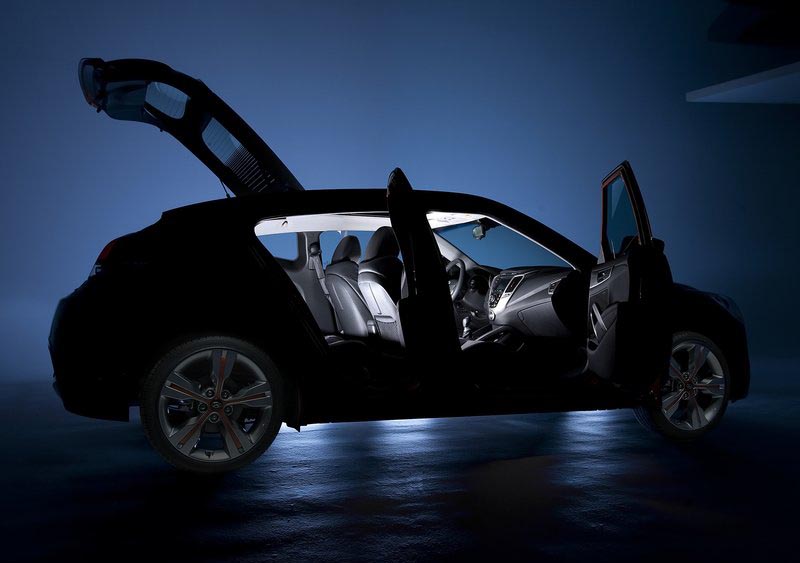
Hyundai introduced its cutting-edge Hyundai Veloster three-door coupe in a world debut at the 2011 North American International Auto Show. The 2012 Veloster delivers innovation to the compact coupe segment with a unique third door for easy rear-seat access, Hyundai's Blue Link telematics system, Pandora internet radio with seven-inch touch-screen display, and a new 1.6-liter direct-injected four-cylinder engine mated to Hyundai's first dual-clutch transmission.

MOTORCYCLE INSPIRATION
Hyundai Veloster's unique design takes inspiration from a high-performance sport bike. Veloster has distinctive black A-pillars that give the glass a motorcycle helmet visor appearance. In the front is an aggressive form of Hyundai's signature hexagonal front grille, hood scoop detailing, and unique Hyundai-signature LED position lights. Optional packages add a chrome grille surround, piano black highlights, fog lights, and a massive panoramic sunroof.

In profile the Hyundai Veloster features "Fluidic Sculpture" character lines, muscular wheel arches, bodycolor door handles and mirrors, and wraparound headlights and taillights. Hyundai Veloster comes standard with 17-inch alloy wheels and offers two types of 18-inch wheels. The top-of-the-line 18-inch wheel comes with painted inserts, a segment first.

Hyundai Veloster's dynamic rear design has a distinctive glass hatch, dual centered chrome exhaust tips and black lower fascia that complements the assertive front fascia.

Inside, the center stack and controls resemble a sport bike fuel tank and incorporate an available push-button starter. The air vents are inspired by motorcycle tailpipes, while the floor console mirrors the seat of a bike. Metallic accents abound throughout the interior. Alloy pedals and a leather wrapped steering wheel and shift knob are also available.

THE THIRD DOOR
Hyundai Veloster combines the style of a coupe and the functionality of a hatchback, while also incorporating an additional passenger-side door. In the past, some coupes have used smaller rear-hinged access doors. These coupes have always been compromised by having to open the driver-side door before the rear door could be opened, proving to be inconvenient for both the driver and passenger, and extremely difficult to operate in tight parking lot situations. Hyundai's fresh take here implements a conventionally hinged door on the passenger side of the Hyundai Veloster, providing safe and ready access to the surprisingly spacious rear seats. The passenger-side rear door handle is hidden to maintain the coupe design.

GAMMA 1.6-LITER GDI ENGINE
The all-new Gamma 1.6-liter four-cylinder engine is the smallest Hyundai engine to use Gasoline Direct Injection (GDI). GDI technology helps deliver estimated highway fuel economy of up to 40 mpg, lower emissions and higher reliability.

"Gasoline-direct-injection technology allowed Hyundai engineers to create an engine that is powerful, fuel-efficient, and has fewer emissions," said Hyundai American Technical Center Inc. (HATCI) powertrain director, John Juriga. "Despite its small size, it generates some big numbers, with both impressive horsepower output and up to 40 mpg on the highway."

Through the use of GDI, the Gamma 1.6-liter engine delivers an estimated peak output of 138 horsepower at 6,300 rpm and maximum torque of 123 lb.-ft. at 4,850 rpm. But GDI is only part of the story as the new Gamma also features Dual Continuously Variable Valve Timing, an electronic throttle control, a roller timing chain, variable induction and innovative anti-friction coatings such as CrN Physical Vapor Deposition (PVD) coating and Diamond Like Carbon (DLC) coating.

NEW SIX-SPEED DUAL-CLUTCH TRANSMISSION
Hyundai's commitment to making the Gamma engine extremely fuel efficient continues by pairing it with a standard six-speed manual transmission or an all-new, six-speed dual-clutch transmission (DCT) developed by Hyundai.

Hyundai's new DCT takes the benefits of a manual transmission, including low fuel consumption and sporty driving, and blends them with automatic transmission benefits, such as high comfort levels and smooth shift quality. In addition, the DCT enables direct connection for high efficiency and uninterrupted torque transfer during shifts. Automatic transmissions lose power and fuel economy in the torque converter.

Other improvements of a DCT over a traditional automatic include a five to six percent improvement in fuel efficiency as well as a three to seven percent improvement in acceleration performance.

Hyundai Veloster's DCT can be thought of as two traditional manual transmissions, each with its own clutch operating in parallel and alternating shifts. Hyundai Veloster is a six-speed with one clutch acting on gears one, three and five and the other used for two, four, six and reverse. This shifting process results in quick smooth transitions with none of the efficiency loss normally associated with torque convertors. The clutch actuator assembly features electric motors for actuation, and an external damper improves NVH.

This powertrain also has an Active Eco mode which modifies engine and transmission control for improved fuel economy that translates into more than a seven percent improvement in real-world fuel economy.

WORLD-CLASS WEIGHT EFFICIENCY
World-class weight efficiency is a program target for all Hyundai models. This strategy delivers outstanding fuel economy and performance simultaneously. At just 2,584 pounds, Hyundai Veloster is more than 400 pounds lighter than the Scion tC. This priority on weight efficiency allows the Hyundai Veloster to deliver a great combination of agility, performance, and fuel efficiency.

FUN TO DRIVE
The Hyundai Veloster is fitted with a McPherson strut front suspension, coil springs, gas shock absorbers and a 24 mm diameter front stabilizer. The rear suspension is a light-weight V-torsion beam, a Hyundai-first with an integrated 23 mm stabilizer bar to allow bracing of the arms for greater stiffness and to further control body roll. The rear suspension also uses monotube shock absorbers for ride comfort.

Hyundai Veloster features sport-tuned electric power steering that adjusts instantly to changing driving conditions while improving fuel economy over a conventional steering system. A quick-ratio steering rack is used for crisp feel on turn-in. Hyundai Veloster's turning diameter of 34.1 feet is better than tC's 37.4 feet, CR-Z's 35.4 feet, Mini's 35.1 feet and Mini Clubman's 36.1 feet. Standard are 215/45HR17 tires on 17-inch alloy wheels. There are two optional 18-inch alloy wheels with lower profile 215/40VR18 performance rubber.

ADVANCED STANDARD SAFETY TECHNOLOGIES: PART OF HYUNDAI'S ASSURANCE COMMITMENT

Veloster has an exceptional level of standard safety features for the sporty car segment. Hyundai Veloster has a Vehicle Stability Management (VSM) system which optimally manages ESC (Electronic Stability Control) and the Motor-Driven electric Power Steering (MDPS).

VSM works to control two effects. The first is when a driver accelerates or brakes on a split-mu surface (slippery on one side, dry pavement on the other) and the vehicle wants to pull in one direction. VSM detects this condition and sends a signal to the MDPS to apply steering assist. VSM counters the pull and automatically provides eight Newton meters of counter steering. VSM reacts the same way during sudden lane changes or fast cornering.

Hyundai Veloster features six airbags—including dual front, front seat-mounted side-impact, and front and rear side curtain airbags.

The Hyundai Veloster also features a state-of-the-art braking package. The package includes four-wheel disc brakes and an Anti-Lock Braking System (ABS) including Brake Assist, which provides maximum braking force when a panic stop is detected, and Electronic Brake-force Distribution (EBD), to automatically adjust the braking force to front and rear axles based on vehicle loading conditions.

CONNECTIVITY/TECHNOLOGY
In the digital age everyone wants to be connected to their electronics at all times, so Hyundai Veloster comes standard with a multifunction seven-inch touch-screen display. At engine start-up, the screen comes to life with a Hyundai Veloster image and a unique sound. There are three interface layouts the user can choose from.

Pandora internet radio is integrated into Hyundai Veloster. The display screen has a Pandora icon to stream internet radio from an iPhone, Android or Blackberry. Pandora can also be viewed on the display screen and songs can be given the familiar Pandora thumbs up or thumbs down by pressing an icon.

Gracenote improves how Hyundai Veloster drivers access and manage their music through licensed cover art, enhanced voice recognition capabilities and "More Like This" automatic playlisting. Gracenote helps organize song metadata from a driver's music collection, and associates specific genre classifications (e.g. Indie Rock, R&B, Classical) with the identified tracks. This lets Hyundai Veloster drivers create targeted similar music playlists with a single button or voice command using Gracenote's Playlist Plus™ technology.

Gracenote MediaVOCS® technology improves the accuracy of the system's voice recognition capabilities for music search and navigation, letting drivers pinpoint bands, artists and albums with hard-to-pronounce names, irregular spellings and nicknames. For instance, Gracenote MediaVOCS helps the system understand artist names like Beyoncé and AC/DC. And drivers can use "The Boss" as a voice command to access tracks from Bruce Springsteen.

Gracenote also powers the Hyundai Veloster's 3D carousel of album cover art, producing a driver-friendly interface that makes it easy to search for music, select albums and display cover art during playback. The combination of these Gracenote technology features provides Veloster drivers a safe and easy way to manage and enjoy their music on the open road.

The head unit features virtual CD downloading which is like having a 10-disc CD changer on board. This feature allows for up to 10 CDs to be stored on the systems memory. The systems memory also allows for viewing and storing of jpeg images, AVI videos and Mpeg videos from a USB stick.

One of the display's unique features is an Eco Coach scoring system. This system acknowledges fuel-efficient driving with an eco rewards score and it accumulates points over time for a total Eco Score. The Eco Coach also provides instant fuel economy feedback so drivers can compare their average fuel economy with other Veloster owners.

With video games being an important element of entertainment, Hyundai integrated a USB jack, RCA jack and 115-volt power outlet in Hyundai Veloster to support gaming consoles for ultimate gaming sessions when in park.

Hyundai Veloster is available with two audio systems. Standard is a 196-watt AM/FM/Satellite Radio/CD/MP3 audio system with six-speakers and iPod®/USB/auxiliary input jacks. A 450-watt Dimension Premium Audio system with eight speakers including an eight-inch subwoofer and external amplifier is available. An XM Satellite Radio interface is also integrated into the head unit and features channel logos and XM Data services, such as XM NavWeather®, XM Stock Ticker and XM Sports Ticker.

A Bluetooth hands-free phone system with voice recognition, address book download and audio streaming is standard. Touch-screen navigation is optional. The system also integrates a rear-view camera, which cannot be found on the CR-Z or tC.

HYUNDAI BLUE LINK
"Blue Link combines safety, service and infotainment into a complete package that works to both help simplify Hyundai owners' lives and reduce distracted driving," said Barry Ratzlaff, director of customer satisfaction and service business development, Hyundai Motor America. "We've carefully studied how drivers rely on smart phones and navigation systems as an innovative link to the outside world. Blue Link brings that seamless connectivity directly into the car with technology like voice text messaging, POI web search download, turn-by-turn navigation, and monthly vehicle reporting. Our agent-assisted advanced voice recognition system offers a 21st century solution to performing POI searches in the vehicle. This unique and innovative approach enables Hyundai to deliver fast, accurate searches and downloads of POIs to vehicles without the unnecessary costs of traditional operator-only type systems of our competitors."

As part of the Blue Link launch, Hyundai also will provide Blue Link Assurance on Blue Link-equipped vehicles, which includes core safety services for an introductory period. These key safety services include: Automatic Crash Notification (ACN) and Assistance, SOS Emergency Assistance, and Enhanced Roadside Assistance. After the introductory period, owners of Blue Link-equipped vehicles can choose to extend these and other services as desired. Blue Link package subscription fees will be announced this spring on Sonata.

Blue Link Assurance further expands Hyundai's industry leadership formerly established by Hyundai Assurance, the industry's most comprehensive suite of new-vehicle protection. Hyundai Assurance already offers a 5-year/60,000-mile fully transferable bumper-to-bumper warranty, Hyundai's 10-year/100,000-mile powertrain warranty, 5-years complimentary Roadside Assistance, and Buyer Protection - a credit-protecting job-loss vehicle return program.