Thứ Hai, 12 tháng 12, 2011

Chevrolet Camaro Convertible, 2011


Chevrolet Camaro Convertible, 2011

The segment-leading Chevrolet Camaro opens a new chapter as the 2011 Chevrolet Camaro Convertible premieres at the 2010 Los Angeles International Auto Show. The new convertible begins production in January and goes on sale in February 2011. It includes an enhanced body structure and well-tailored top mechanism - a combination designed to deliver sports coupe-like driving fun and precise quality.

Camaro seized leadership in U.S. sales in its segment with the original coupe model that launched in spring 2009 as a 2010 model. The right to purchase one of the first convertibles was recently sold at the Barrett-Jackson auction for $205,000, with all proceeds donated to charity. The 2011 Chevrolet Camaro Convertible Neiman Marcus Edition, a group of 100 exclusive cars with custom-designed elements and priced at $75,000 each, sold out in only three minutes.

The Chevrolet Camaro convertible delivers great refinement, along with uncompromising, coupe-like driving dynamics. Its enhanced body structure helps prevent cowl or steering wheel shake, for a strong, confident feel in all driving conditions. The top has a smooth, tailored fit, with acoustical foam in the headliner that helps deliver a quiet ride with the top up.

The Chevrolet Camaro convertible is offered in 1LT/2LT (V-6) and 1SS/2SS (V-8) trim packages and priced from $30,000 MSRP (including $850 destination). Nine production exterior colors are available, with tops offered in black or tan. Rear parking assist is standard on all convertible models.

Strong structure
The Camaro's architecture was designed to accommodate a convertible model, which means customers enjoy the fun of top-down cruising with coupe-like driving dynamics. Four strategic reinforcements enhance the already-stiff body structure to eliminate common convertible maladies of cowl and steering wheel shake.

The result is a convertible that preserves nearly all the acceleration, road-holding and performance capabilities of the Camaro coupe.
Additional safety structural reinforcements are designed to improve noise and vibration characteristics, while also contributing to the elimination of cowl/steering wheel shake. They include a hydrofromed tube in the A-pillars, an inner reinforcement bracket in the windshield header, a reinforced front hinge pillar and reinforcements inside the rockers.

Exceptional top refinement
At the outset, designers and engineers sought to eliminate the common appearance of convertible top support ribs and they succeeded, using composite knuckles rather than aluminum ones, as well as extending the top material below the belt line and revising the top's stitch lines. The result is a top that has a smooth, taut and carefully tailored appearance that also retains the sleek roofline of the coupe.

The power-folding top retracts in about 20 seconds. It is built in partnership with the same manufacturer as the Corvette convertible top, and operates in a similar manner. That means it folds in a simple "Z" pattern and latches with a single, convenient handle located at the center of the windshield header. Other convertible models in this segment still offer convertible tops with dual latches, forcing drivers into two-hand operations reaching across the car.

Once the latch is turned to the open position, the push of a single button lowers the windows and activates the top. The car doesn't have to be parked for the top to be activated, allowing for spur-of-the-moment lowering while stopped at a stoplight.
The top is made of thick, durable canvas and it features acoustical headliner material that provides a quiet, coupe-like ride when the top is up. It also incorporates a glass rear window and rear window defogger.
A folding, one-piece tonneau cover is standard on 2LT and 2SS models and optional on 1LT/1SS. It covers the folded top for a finished appearance. An accessory windscreen is available from Chevrolet dealers. It installs behind the front seats to limit wind buffeting when driving with the top down.

Additional details
A myriad of fine details distinguish Camaro convertible models, including:

Because the combined OnStar/XM/AM-FM radio antenna is mounted on the roof of coupe models, it had to be relocated on the convertible. On RS-equipped LT models and SS models, which include a rear spoiler, a small "shark fin" OnStar/XM antenna is mounted on the deck lid, while the AM/FM radio antenna is hidden inside the rear spoiler. This patent-pending design creates a sleeker appearance. For LT models without a rear spoiler (without the RS package), the combined antenna is located in the center of the deck lid.

The relocation of the trunk lock cylinder also cleans up the Chevy Camaro convertible's appearance, moving from the panel between the taillamps to a discreet area between the rear seat back cushion and driver's side interior panel. The change retains full, lockable access to the trunk, with the keyless remote fob also offering easy trunk access.
Finally, the subwoofer - either an eight-inch unit with the base sound system or a 10-inch subwoofer with the available Boston Acoustics system - is relocated from the trunk to an area between the rear seat cushions.

The Performance
Camaro LT convertible models are offered with a 3.6L direct injection (DI) V-6 that delivers more power through increased efficiency, while maintaining fuel economy and lowering emissions - including a 25-percent drop in cold-start hydrocarbon emissions. It is rated at 312 horsepower (232 kW) and 278 lb.-ft. of torque (370 Nm). Peak fuel economy with the direct injection V-6 is 29 miles per gallon on the highway.

Two 6.2L V-8 engines are offered in Camaro SS models, including the L99 on automatic-equipped vehicles and the LS3 on manual-equipped models. Both engines are derived from the LS3 that debuted on the 2008 Corvette, with an aluminum block (with cast iron cylinder liners) and aluminum cylinder heads. Horsepower for the L99 is 400 (298 kW) and torque is 410 lb.-ft. (556 Nm). The LS3 develops 426 horsepower (318 kW) and 420 lb.-ft. (569 Nm).

The L99 features the fuel-saving Active Fuel Management System, which saves fuel by shutting down half of the engine's cylinders during certain light-load driving conditions, such as highway cruising.

The all Camaro models can be equipped with either a six-speed manual or six-speed automatic transmission. The Aisin AY6 six-speed manual is standard with the 3.6L engine, and a Hydra-Matic 6L50 six-speed automatic is optional. A Tremec TR 6060 six-speed manual is standard on the SS, and the Hydra-Matic 6L80 six-speed automatic is optional.

Chevrolet Camaro Convertible Neiman Marcus, 2011


Chevrolet Camaro Convertible Neiman Marcus, 2011

A special edition of the 2011 Chevrolet Camaro Convertible showcased in the annual Neiman Marcus "Christmas Book," the luxury retailer announced.

Only 100 special edition convertibles built, each offering luxury appointments inspired by Neiman Marcus combined with the legendary performance of the Camaro SS. This is the 84th edition of the luxury retailer's catalog of ultimate holiday gifts. Neiman Marcus debuted the Christmas Book and the special edition Chevrolet Camaro Convertible at its flagship store in Dallas.
The Deep Bordeaux color is complimented by a color-matched fabric top and windshield frame finished in matte silver, both also exclusive to the Neiman Marcus edition.

The interior of the Chevrolet Camaro Convertible Neiman Marcus Edition features exclusive leather interior appointments, including amber-colored leather seating surfaces offset by black leather side panels and red stitching. Red accents also appear on the center console, steering wheel and shift knob. The Deep Bordeaux color from the exterior is brought inside the car, appearing on the dash and door panels.

The Chevrolet Camaro Convertible Neiman Marcus has a retail price of $75,000, and will be ready for delivery in the spring of 2011. Reservations for one of these limited-edition cars will be accepted beginning at noon, EDT, on October 19, 2010.

The Chevrolet Camaro Convertible Neiman Marcus equipped with a 6.2-liter, V-8 engine, When paired with six-speed manual transmission, the engine delivers 426 horsepower and 420 pound-feet of torque; with the six-speed automatic, the engine delivers 400 horsepower and 410 pound-feet of torque.

The Chevrolet Camaro Convertible Neiman Marcus also has exclusive, 21-inch, polished aluminum wheels, wrapped in Pirelli P-Zero ultra-high performance tires. Other features include Brembo disc brakes, LED halo-ring headlamps, Bluetooth connectivity, rear parking assist, and a 245-watt, Boston Acoustics sound system.

Chủ Nhật, 9 tháng 10, 2011

Porsche 911 Turbo S, 2011


Porsche 911 Turbo S, 2011

The engineers at Porsche have developed the new Porsche 911 Turbo S in response to customer demand for greater power, performance and driving dynamics. Building on the success and reputation of the revered Porsche 911 Turbo, at the heart of this most exclusive high-performance athlete is a six-cylinder 'boxer' engine boosted by two turbochargers with variable turbine geometry.

An increase in horsepower over the Porsche 911 Turbo of 30 hp boosts peak output to 530 hp (390 kW) and maximum torque is a most impressive 700 Newton-metres (516 lb-ft). Despite its significant increase in power and dynamic performance, the new Porsche 911 Turbo S returns 24.8 mpg Combined (11.4 l/ 100 km) and as such offers identical fuel consumption to the regular Porsche 911 Turbo, making it by far the most efficient sports car in its performance class.

The Porsche 911 Turbo S offers as standard the high technology features that are otherwise available as options on the 911 Turbo. Thus, the Porsche 911 Turbo S comes exclusively with the seven-speed Porsche Doppelkupplungsgetriebe (PDK) double-clutch gearbox - with steering wheel-mounted paddle shift levers - which conveys drive power to Porsche Traction Management (PTM) all-wheel drive. Driving enjoyment and safety is optimised to an even higher standard courtesy of the Dynamic Engine Mounts, and Porsche Torque Vectoring (PTV) including a mechanical limited slip rear differential.

In conjunction with the Launch Control function of the Sport Chrono Package Turbo that is also fitted as standard, the Porsche 911 Turbo S accelerates from a 0-62 mph (0-100 km/h) in 3.3 seconds and reaches 124 mph (200 km/h) in 10.8 seconds. Top speed is 196 mph (315 km/h). Lightweight and fade-resistant Porsche Ceramic Composite Brakes (PCCB) provide the same outstanding performance in terms of stopping power.

Further underlining the outstanding class and calibre of this first Porsche 911 Turbo S in five years, the supreme level of standard equipment also includes Dynamic Cornering Lights, 19-inch RS Spyder design wheels with centre lock nut, adaptive sports seats, cruise control, a CD/DVD changer and exclusive two-tone leather upholstery in Black/Creme or Black/Titanium Blue.

The new Porsche 911 Turbo S goes on sale from May 2010 priced from £123,263 in Coupe bodystyle and from £130,791 as a Cabriolet. Fitted to every Turbo S is a Porsche Vehicle Tracking System (VTS), a sophisticated vehicle security package approved to Thatcham Category 5 standard. Further technical and specification details will be confirmed nearer the on-sale date.

To explore the dynamic attributes of their Porsche 911 Turbo S, and further develop their own skills behind the wheel, courtesy of a Driving Experience Programme at the Porsche Experience Centre at Silverstone.

Thứ Tư, 28 tháng 9, 2011

Scion tC, 2011

 
 Scion tC, 2011

Launched in 2004, the Scion tC quickly became Scion's top-selling vehicle, at the same time attracting the youngest buyer in the entire industry. Six years later, the second-generation Scion tC emerges with an aggressive new look, increased driving performance, and a more premium feel.

Enhanced performance is accomplished in the second-generation Scion tC with an all-new 2.5-liter inline four-cylinder engine with dual VVT-i that generates 180 horsepower, 19 more than the previous model, and 11 additional lbs.-ft of torque. In addition to increases in power, the new engine delivers an increase in fuel economy all while lowering emissions. Performance is further improved and heard through a new intake manifold design and a sport-tuned exhaust system that delivers a bold and aggressive sound.

The Scion tC features two all-new transmissions: the six-speed manual transmission has improved shift-feel and adds to the car's already fun-to-drive character, and a new six-speed automatic gains two gears along with sequential-shift.

The 2011 tC enters its second-generation riding on a new platform, including a specially tuned MacPherson strut front-suspension and a double-wishbone rear-suspension that rides lower than the previous model. Larger 18-inch aluminum-alloy wheels are wrapped in wider tires, giving the Scion tC a broader stance and elevated handling characteristics. The new model also comes standard with larger 16-inch disc brakes on all corners. A new performance-tuned electronic power-steering system provides the driver a confident feel that is more in-tune with the road. The elements brought together in the new chassis result in a premium performance that expands the Scion tC into a new dimension of driving enjoyment.

The design of the 2011 Scion tC projects a bolder and more aggressive stance. Important design cues like the helmet-inspired cabin shape were adopted from the Calty-designed Scion FUSE concept, which was unveiled at the 2006 New York Auto Show. The protruding fender flares amplify its wider, lower stance and are aggressively complemented by a sleek front grille and projector headlamps. The shape of the rear taillights flow cleanly into the overall shape of the trunk.

The Inside, a driver-focused cockpit starts with a sporty new three-spoke steering wheel that features a flat bottom and a new shape that offers a confident grip. Front seats feature robust bolsters that provide secure positioning while still offering spaciousness and comfort. The instrument-panel, gauge cluster and center-console all face inward in a V-shape, making controls easily accessible.

The cabin has been lengthened for a more comfortable passenger experience with increased versatility. Utility is enhanced with reclining rear seats that split 60/40, providing more storage capacity. The panoramic moonroof remains standard in the new Scion tC.

The new tC comes standard with an AM/FM/CD/USB audio system that features eight speakers. As with all Scion models, steering-wheel-mounted controls allow the driver to easily navigate through all of their music.

The new Scion tC is also reinforced with key safety features and is expected to achieve top safety ratings. In addition to standard Anti-lock Brakes (ABS), the new Scion tC also gains standard Vehicle Stability Control (VSC), traction control (TRAC), Electronic Brake Force Distribution (EBD) and Brake Assist (BA). Active front-headrests and eight airbags are also standard, including both driver and front-passenger knee airbags.

Scion iQ, 2011


Scion iQ, 2011

The Scion iQ succeeds at taking big ideas and concentrating them into a small package. Made possible by intelligent and functional packaging, the Scion iQ is a small car that offers the functionality and comfort that drivers expect from a car twice its size.

The Scion iQ's profile, defined by a strong and high beltline, glides from the large, stout headlamps, up the A-pillar, across the roof and wraps around the rear, emphasizing the Scion iQ's geometric shape. Side mirrors with integrated turn signals accent the clean design.

The rear emphasizes the vehicle's modern style. Trapezoidal lines run toward the wheels, from the hatch to the bumper's rear diffuser-like accent, creating a substantial presence. With a 78.7-inch wheelbase and a unique suspension design - consisting of MacPherson struts up front, and a torsion beam rear suspension - the three-door hatchback can deftly maneuver through city traffic. In addition, its overall length of only 120.1-inches, width of 66.1-inches, and short front and rear overhangs create a confident stance that still allows the Scion iQ to fit into virtually any urban parking scenario.

Engineering innovations like a compact air-conditioning unit, inverted front-mounted differential, and electronic power-steering system with compact steering column, all amount to significant decreases in front-end length. In addition, the Scion iQ is equipped with a flat gas tank housed beneath the floor that reduces rear overhang.

The Scion iQ's functional "3+1" seating equates to the world's smallest four-passenger vehicle. With the driver's and front-passenger's seats being slightly off set, this innovative seating arrangement allows for one adult behind the front passenger and a child, small package, or pet behind the driver. A first for Scion, extra-slim front seat backs are utilized to provide rear passengers with ample legroom. The rear seats are extremely versatile, featuring a 50/50 split and the ability to fold flat, creating enough storage to accommodate up to two golf bags.

The Scion iQ is small in size but large on safety. Active safety features include Vehicle Stability Control (VSC), an anti-lock brake system (ABS) with Electronic Brake force Distribution (EBD), Brake Assist (BA) and Traction Control (TRAC).

The Scion iQ will come standard with 10 SRS airbags, including the world's first rear-window curtain airbag. Other airbags include driver- and front-passenger airbags; driver- and front-passenger seat-mounted side airbags; side curtain airbags; driver- and front-passenger knee airbags; and a Scion-first driver seat-cushion airbag.

The 2011 iQ is equipped with a 1.3-liter, four-cylinder engine that produces over 90 horsepower and features the latest dual VVT-i, which allows it to be impressively efficient, providing a broader powerband yet requiring less fuel and generating fewer emissions.

The Scion iQ's engine is combined with a Continuously Variable Transmission (CVT) that helps deliver smooth acceleration and excellent fuel efficiency. The Scion iQ will be rated as an Ultra Low Emission Vehicle (ULEV-II), and it is expected to achieve a combined fuel economy in the high 30s, comparable to similar vehicles that feature less passenger and cargo capacity.

The Scion iQ comes standard with a six-speaker audio system and is available with multiple audio head units for various degrees of audiophiles. All iQs will be outfitted with USB and auxiliary ports, allowing personal devices to be easily integrated into the car. Steering-wheel-mounted controls command the audio system to adjust volume and shuffle through music sources such as CD, AM/FM, auxiliary input, or a library from your iPod or other USB device.

Thứ Tư, 14 tháng 9, 2011

Opel Flextreme GT-E Concept, 2010


Opel Flextreme GT-E Concept, 2010

Opel Flextreme GT/E Concept made its debut at the 80th Geneva Motor Show (March 4 - 14, 2010), it will boost the company's credentials as a leader in green technologies, offering expressive design with efficient environmental performance - and engineered with German precision.

In Opel's strategy for achieving more independence from fossil fuels, electricity plays a key role. The 4.7-meter long Opel Flextreme GT/E Concept illustrates how extended-range electric vehicle (E-REV) technology can be plugged into large or mid-size vehicles, as well as compact cars such as the upcoming Opel Ampera.

Opel calls this strategy e-mobility unlimited: adapting the highly efficient E-REV drive system - which removes the limitations of battery-only power - to vehicles across all market segments. To enjoy zero CO2 driving emissions Opel-style, the Flextreme GT/E concept shows that size doesn't matter.

The purposeful design also enables the Opel Flextreme GT/E Concept to achieve a projected drag co-efficient of just 0.22, which helps it reach a 200 km/h-plus top speed as well as conserve energy and extend its driving range. Stand-out visual features include a low and wide stance, wing-shaped lights front and rear, a distinctive nose and grille, floating C-pillars and muscular, sculptured bodywork.

Exterior design: expressing efficiency with emotion

The low, coupé-like proportions of the Opel Flextreme GT/E Concept explore the potential for evolving Opel's new design language - sculptural artistry meets German precision - within an envelope optimized for aerodynamic efficiency.

The clean, frontal styling features a low hood line and an extended nose section, which is clasped by wing-shaped, signature LED headlamps. These are deeply carved into the front fenders and across the hood line. The new trapezoidal grille execution is slim but bold. The prominent wing-shaped chrome bar carries a large Opel emblem, which doubles as a socket for charging the Opel Flextreme GT/E Concept's battery pack.

The upper section of the grille is used to admit cooling air, the lower portion being covered by a translucent panel. The absence of additional air intakes allows a low frontal area for aerodynamic efficiency and also enables the Opel Flextreme GT/E Concept to meet future pedestrian protection requirements.
The sculpted hood, with an Opel signature central crease line, features narrow longitudinal vents on either side to draw air out of the engine compartment. The muscular fenders and wheel-arches sweep back into the side-body.

In profile, the Opel Flextreme GT/E Concept is distinguished by innovative, stubbed C-pillars. This floating design allows the glasshouse to be extended rearwards under the arching roofline, emphasizing the flowing lines of the side body. The car's dynamic character is further underlined by a fresh expression of Opel's signature blade motif, now a swooping swage line from the base of the C-pillar into the lower front fender.

Access to the cabin is enhanced by the adoption of rear-hinged rear doors, an evolution of the Opel FlexDoors concept from the new generation Meriva monocab. To preserve the clean exterior looks, all door handles are replaced by light sensors. These trigger the doors open when covered by the driver's or passenger's hand. To reduce air turbulence, exterior front door mirrors are also absent, replaced by small camera pods in the base of the A-pillars.

At the rear, a strong shoulder line embraces sculpted wheel-arches that further emphasize the Opel Flextreme GT/E Concept's wide, ground-hugging stance. The coupé look is completed by a steeply raked tailgate, carrying wing-shaped LED light units which echo the form of the front headlamps. Like that of the Insignia Sports Tourer, the tailgate has a wraparound design for improved trunk access. Its deep glass screen is slightly convex to improve airflow.
The translucency of the fixed glass panel in the center of the roof is adaptive, allowing sunlight to warm the interior in the cold of winter, but darkening for coolness in summer. A duct at the rear edge of the roof is for additional cooling of the battery and electronic components.

Managing airflow and saving weight

Integral to the Opel Flextreme GT/E Concept's expressive looks is the efficiency of the design execution. The small frontal area, low roof height (1308 mm) and a flat, enclosed underbody all enable the car to cleave the air with a minimum of disturbance.
A series of measures optimize airflow management. The 21-inch alloy wheels are relatively narrow, to reduce wind resistance, and fitted with 195/45, low rolling resistance tires. Clear, flush-mounted trim inserts also minimize air turbulence.

The minimal front intake improves airflow around the nose of the car and the underbody sweeps up, venturi-like, at the rear to further reduce drag.
The Opel Flextreme GT/E Concept also explores the potential for active shape shifting. At speeds above 50 km/h, a vertical panel extends along the body from the air extraction slot behind each rear wheel-arch. These 350 mm-long side spoilers guide high-speed airflow around the rear corners of the car, further reducing the amount of turbulence.

Mass reduction measures for the body include the use of lightweight, carbon composite outer panels, polycarbonate window glazing and aluminum alloy structural components. Compared to conventional materials, these offer a 40 percent weight saving which further contributes to reduced energy consumption and an increased driving range.

Innovative propulsion

The efficient concept also includes GM's ground-breaking E-REV drive system, already developed for the Opel Ampera. The Opel Flextreme GT/E Concept shows the versatility of this technology by displaying it in a larger, mid-size vehicle format.

Despite its greater size and a maximum speed of more than 200 kilometers per hour, the Opel Flextreme GT/E Concept is projected to offer performance similar to that of the Ampera: a battery-powered driving range of up to 60 km - with zero CO2 tailpipe emissions - and a total range of more than 500 km. Average fuel consumption is estimated at 1.6 l/100 km, with CO2 emissions of less than 40 g/km.

Unlike a hybrid vehicle, the wheels of the Opel Flextreme GT/E Concept are powered at all times by electricity. For typical journeys up to 60 km, energy is supplied by a T-shaped lithium-ion battery pack located under the floor and rear seat.

However, unlike a battery-only electric vehicle, the Opel Flextreme GT/E Concept eliminates any possibility of range anxiety through fear of being stranded without power. The small gasoline engine/generator is seamlessly engaged to provide electricity whenever the battery's supply becomes depleted. In this mode, the driving range is extended to more than 500 km, until the plug-in battery pack can be recharged or the car is refueled.

The motor in the electric drive unit delivers a substantial 370 Nm of instant torque, giving lively performance and projected zero to 100 km/h acceleration in less than nine seconds.
The Flextreme GT/E concept is a further step in Opel's unfolding strategy for the electrification of the automobile, which includes a wide portfolio of products using battery, extended-range, hybrid and fuel cell technologies.

Opel Flextreme GT/E Concept: Technical Data
    * Body style
          o Type: 5-door coupé, 4-seat upper mid-size concept vehicle
          o Co-efficient of drag: 0.22
    * Exterior dimensions
          o Overall length: 4762 mm
          o Height: 1308 mm
          o Width: 1871 mm
          o Wheelbase: 2900 mm
          o Front track: 1600 mm
          o Rear track: 1600 mm
    * Wheels/Tires
          o Wheel size: 21 inch
          o Tires: 195/45 R 21; extra low-rolling resistance
    * Powertrain
          o Type: Electric drive, front-wheel-drive
    * Battery system
          o Type: Advanced lithium-ion (manganese spinel)
          o Energy: 16 kWh
          o Nominal voltage: 350 volts
          o On-board charger: 3.3 kW
          o 100% recharge time (230V outlet): < 3.0 hours
    * Electric drive unit
          o Max. power: 120 kW
          o Torque: 370 Nm
    * Generator
          o Power: 53 kW peak output
          o Engine type: 4-cyl. 1.4l gasoline-fueled combustion engine
    * Performance
          o Pure electric mode range: 60 km
          o Full range, range extender engaged: > 500 km
          o CO2 emissions, combined cycle (est.): < 40 g/km
          o 0 - 100 km/h acceleration: < 9.0 seconds
          o Maximum speed: > 200 km/h

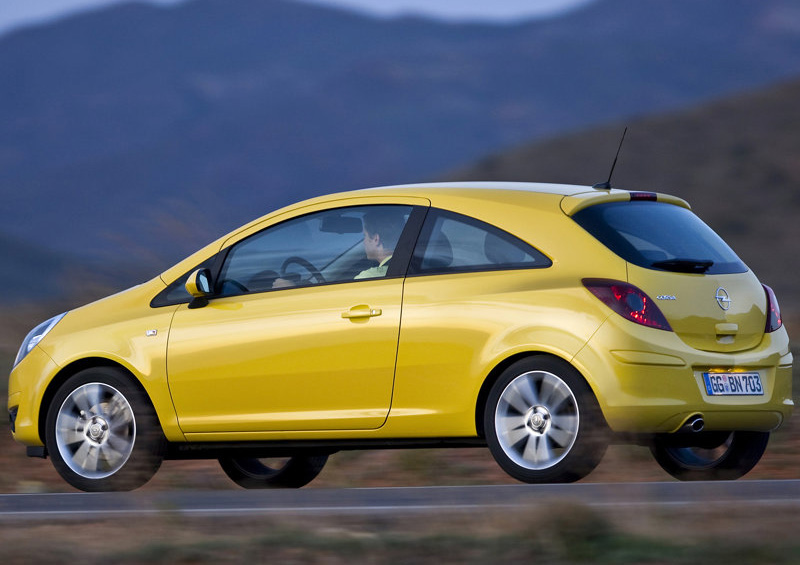
Opel Corsa, 2010


Opel Corsa, 2010

The Opel Corsa range has been rejuvenated to provide more power and more driving fun with less fuel consumption. Opel engineers have given the Opel Corsa a complete make-over, introducing an enhanced powertrain line-up that reduces fuel consumption by up to 13 percent, significant chassis improvements and a new steering calibration. In addition to its agile handling and greater ride comfort, drivers will appreciate engines that give more pulling power.

The enhancements are accompanied by the introduction in Germany of several new special editions like the sporty Color Line series. The Color Race, Color Edition and Color Wave variants feature distinctive bodywork finishes and attractive 17-inch alloy wheels. Also, in celebration of 111 years of automotive tradition, Opel will release a captivating 111 Limited Edition in Europe.

The Opel Corsa comes in two distinct body styles, the coupé-like three-door and the family friendly five-door. Inside the cabin, the Opel Corsa continues to offer one of the roomiest and most attractive interiors in its class. True to Opel's philosophy, it also features innovative technologies at an affordable price, including halogen Adaptive Forward Lighting (AFL), a heated steering wheel, active front head restraints, Hill Start Assist, a Panorama sunroof or the integrated FlexFix bicycle carrier which is unique to Opel.

The Opel Corsa is a highly popular choice throughout Europe, accounting for some 30 percent of all Opel/Vauxhall sales. In addition to its athletic dynamic styling and great driving fun, it also offers customers top class quality. Germany's DEKRA Defect Report 2010 named the Opel Corsa the overall winner, with the lowest defect rate (2.4 percent) of all the vehicles tested. DEKRA (Deutscher Kraftfahrzeug-Überwachungs-Verein) is a full-service provider for safe and efficient mobility and Europe's leading technical expert organization.

More power with improved fuel economy

The powertrain line-up consists of a wide offer of gasoline engine from the 1-liter 3 cylinder (48 kW/65 hp ) entry level version to the turbo charged 1.6-liter on the Opel Corsa OPC (141 kW/192 hp). On the diesel side, different versions of the 1.3 and 1.7 CDTI motors offer outputs ranging from 55 kW/75 hp to 96 kW/130 hp all with fuel consumption under 5 liters per 100 kilometers. The Opel Corsa ecoFLEX 1.3 l CDTI offers exceptionally low CO2 emissions of just 98 g/km for the 3-door variant, 99 g/km for the 5-door.

Opel engineers have developed the engines to give greater torque, while at the same time reducing their appetite for fuel and lowering CO2 emissions. All gasoline engines, and the new 1.7 CDTI diesel, comply with Euro 5 emissions standards.

The most popular gasoline powertrains - 1.0, 1.2 and 1.4-liter with manual and automated Easytronic transmissions - offer combined cycle fuel consumption between just 5.0 and 5.5 l/100 km, and CO2 ratings from 117 to 129 g/km with manual transmission. With an average fuel consumption of just 5.0 l/100 km and 117 g/km CO2, the Opel Corsa 1.0 is the cleanest of all gasoline-powered entries in its segment. The 1.4 engine comes in two variants, with 64 kW/87 hp and 74 kW/100 hp and is available with full automatic transmission in its most powerful execution. The 1.2 and 1.4-liter Twinport engines are now fitted with double cam phasing to allow variable valve timing on both inlet and exhaust sides for more efficient breathing.

The 1.3 CDTI engine is also improved, giving the Opel Corsa ecoFLEX model exceptionally low CO2 emissions of just 98 g/km for the 3-door variant, 99 g/km for the 5-door. The Corsa ecoFLEX is Opel's lowest emitting car, yet it is packed with 27 percent more power and 10 percent greater fuel efficiency. A diesel particulate filter and the "shift up" indicator in the cluster are standard.
The top-of-the-line 1.7 CDTI diesel engine now offers more power and torque - increased to 96 kW/130 hp and 300 Nm - as well as a nine percent cut in CO2 emissions and fuel consumption, to 118 g/km and 4.5 l/100km.

Uprated chassis and steering

Opel chassis engineers have upgraded all major suspension components and the steering system. The result is improved ride comfort, more precise steering feel and greater directional stability - without compromising Opel Corsa's acclaimed agility.

Dampers, springs, anti-roll bars, the rear axle, the electric steering gear and its calibration software all have been optimized. All the changes apply to Essentia, Enjoy and Cosmo variants, while versions equipped with the Sport chassis, GSi and ecoFLEX models benefit from additional improvements to the rear axle and steering. The Opel Corsa OPC took over the changes applied to the steering gear.